
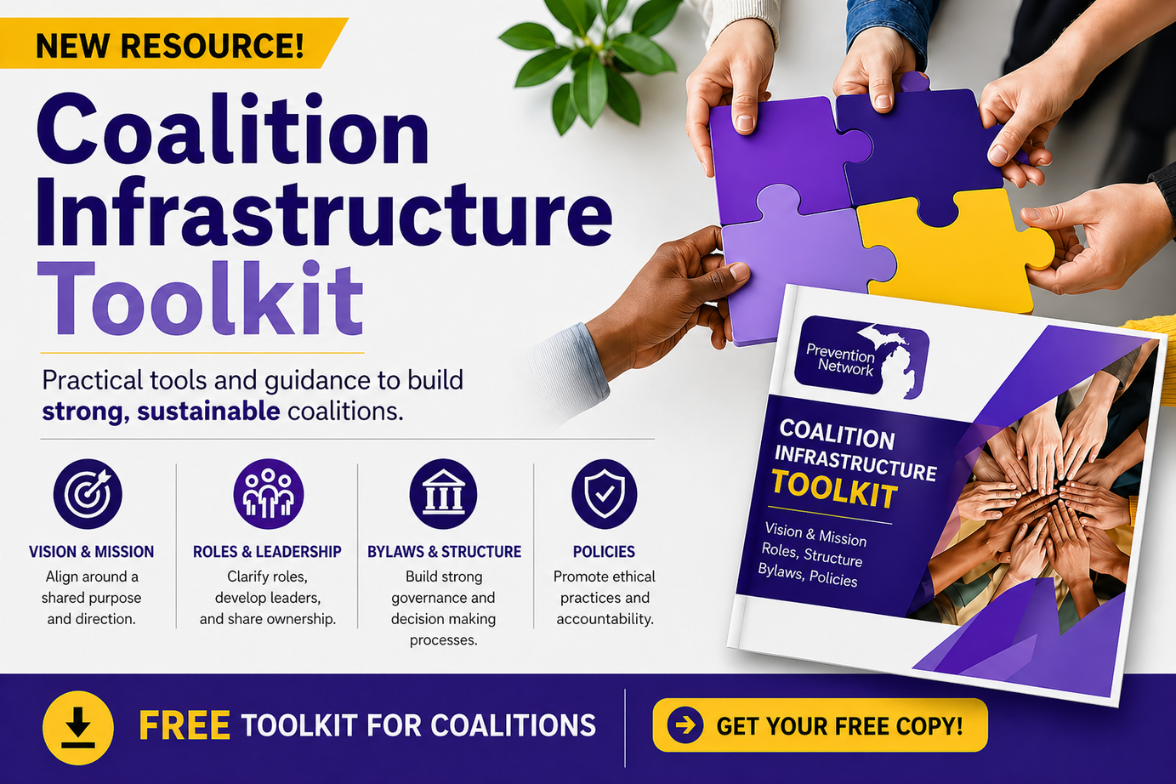
NEW! FREE Resource
Coalition Infrastructure Toolkit
Prevention Network is rolling out a new resource, 2026 Coalition Infrastructure Toolkit, aligned with the MDHHS PFS–SPF workplan.
This free resource helps coalitions build strong, sustainable infrastructure with practical, customizable tools to clarify roles, strengthen governance, support ethical and financial accountability, and define a clear mission and vision.
This toolkit is designed to support coalitions at all stages of development in building strong, sustainable infrastructure. It provides practical tools and guidance to strengthen governance, clarify roles, and align coalition efforts around shared goals.
Coalitions may be in different phases of development—whether just forming, growing, or refining their work. This toolkit is intended to meet coalitions where they are and provide support along the way.
Leading Through Change: How Coalitions Can Stay Grounded and Move Forward
Change is something every coalition and prevention organization experiences—whether it’s staffing transitions, funding shifts, community challenges, changing priorities, or evolving public health trends. While change can feel overwhelming, it can also create opportunities for growth, stronger partnerships, and renewed focus.
Coalitions are uniquely positioned to help communities adapt during times of uncertainty because prevention work is built on collaboration, trust, and shared purpose. Strong coalitions continue moving forward by staying connected to their mission while remaining flexible in how they respond to emerging needs.
A few ways coalitions can lead effectively through change include:
- keeping communication open and transparent with members and partners
- revisiting goals and priorities regularly
- focusing on relationship-building and community engagement
- using local data to guide decisions
- supporting member wellness and preventing burnout
- celebrating progress, even small wins
Change does not always require a coalition to start over. Often, it is an opportunity to strengthen infrastructure, improve processes, and refocus efforts on what matters most to the community.
As prevention professionals continue navigating changing environments across Michigan, collaboration and adaptability remain essential tools for building healthy, resilient communities.
Resource Highlight: CADCA recently shared additional strategies on coalition leadership and navigating change. Their article reinforces the importance of flexibility, sustainability, and strong community partnerships in prevention work.
Source: CADCA
Behavioral Health Expansion Brings Opportunities—and Questions—for Prevention
The U.S. Department of Health and Human Services recently announced the addition of 10 states to the Certified Community Behavioral Health Clinic (CCBHC) Medicaid Demonstration Program, a model designed to expand access to mental health, substance use treatment, recovery supports, and crisis services.
Since launching in 2017, the CCBHC model has grown to more than 500 clinics nationwide, providing communities with increased access to coordinated behavioral health care and sustainable Medicaid funding. Supporters point to improved access to treatment, 24/7 crisis services, care coordination, and recovery supports as major benefits of the model.
At the same time, prevention professionals may note that much of the funding is directed toward treatment and crisis response rather than primary prevention efforts. As behavioral health systems continue to expand, it remains important to ensure that prevention strategies, youth-focused initiatives, and community-based prevention programs remain part of the conversation.
For preventionists, this announcement serves as a reminder that prevention, treatment, recovery, and crisis services are all part of a comprehensive behavioral health system. Looking ahead, opportunities may exist to strengthen partnerships between prevention providers and CCBHCs to better address community needs across the continuum of care.
- June 10, 2026, Fresh Perspectives in Suicide Prevention 2026
- June 17, 2026, 2026 Annual Midwest Conference on Problem Gambling and Substance Abuse
- July 14, 2026, Michigan Substance Use Disorder Prevention Coalition Conference
- July 26-29, 2026, The Power of Prevention National Conference on Substance Misuse.
- August 24-26, 2026, Alcohol Law & Policy Conference
- August 29-31, 2026, EMPOWER 2026: the NAADAC Annual Conference
- September 29 – 30, Virtual, 2026 National Prevention Network (NPN) Conference
- October 29-30, 2026, Connections in Prevention Annual Conference
See the full calendar of events here.
Join Our Network
By joining our *no-cost* network, you will have exclusive access to:
- A resource library filled with handouts, toolkits, templates, videos, and more
- A forum to network with other coalitions
- A map of other coalitions across the State.
Here’s how to use it:
- Go to https://www.preventionnetwork.org/resource-library/
- Type a keyword into the search bar (try a topic, program area, or content type).
- Open a resource to view, download, or save for later.
Whether you’re building a training, writing a grant, or looking for ready-to-use tools, the right resource is only a few clicks away.
Looking for Technical Assistance Support?
Prevention Network offers technical assistance (TA) to help strengthen and support your prevention efforts. Whether you’re planning, implementing, or refining your work, we can connect you with additional resources, tools, and guidance tailored to your needs. Technical assistance may include consultation calls, webinars, trainings, or ongoing support over time to address specific goals or challenges.
Learn more or request support: https://www.preventionnetwork.org/ta/
Upcoming PTTC Trainings for Prevention Professionals
Visit the PTTC Network’s training and events calendar to find upcoming prevention trainings and professional development opportunities available to the Great Lakes region. https://pttcnetwork.org/training-and-events-calendar/
The Prevention Network newsletter delivers timely and comprehensive state and national updates, covering the latest news, research findings, and best practices in the prevention field, ensuring you stay well-informed and equipped to address emerging challenges and opportunities in your prevention efforts. Check out some national and state updates below:
NATIONAL:
SAMHSA Expands Support for 988 Crisis Lifeline and Prevention Services
SAMHSA recently announced a $255 million award to continue administration of the 988 Suicide & Crisis Lifeline, helping ensure that individuals experiencing a mental health, substance use, or suicidal crisis can access immediate support 24/7 through call, text, chat, and videophone services.
Since launching in 2022, the 988 Lifeline has received more than 25 million contacts nationwide, highlighting the growing need for accessible behavioral health crisis services across communities, including here in Michigan.
In addition to supporting 988, SAMHSA announced more than $28 million in new funding opportunities focused on suicide prevention, youth mental health, substance use disorder treatment, and disaster crisis counseling.
For prevention professionals, coalitions, schools, and community partners, these investments continue to reinforce the importance of early intervention, prevention, and strengthening local behavioral health support systems.
If you or someone you know is struggling, call or text 988 or visit 988 Lifeline for confidential support.
STATE
Federal Funding Supports Michigan Public Health and Community Resilience Efforts
Michigan will receive approximately $3 million in new federal funding through FEMA to support COVID-19 response reimbursement efforts and infrastructure improvements aimed at reducing future public health and sanitation risks.
Funding will help reimburse healthcare systems, schools, and public agencies for pandemic-related emergency measures, while additional support will strengthen sanitation infrastructure in Macomb County to help prevent future sewer backups and community disruptions.
The announcement highlights the continued importance of investing in community resilience, emergency preparedness, and public health infrastructure — all key components in supporting healthier, safer communities across Michigan.
As prevention professionals continue addressing behavioral health, substance misuse, and community wellness, investments in long-term public health systems and local preparedness remain an important part of prevention-focused community planning.
Source: Detroit news
Thank you for reviewing Prevention Network’s newsletter! If you have any feedback regarding this newsletter or ideas for our next newsletter, please email us at info@preventionnetwork.org. Lastly, a special thanks to Prevention Network’s Board of Trustees for supporting our mission, vision, and goals.
