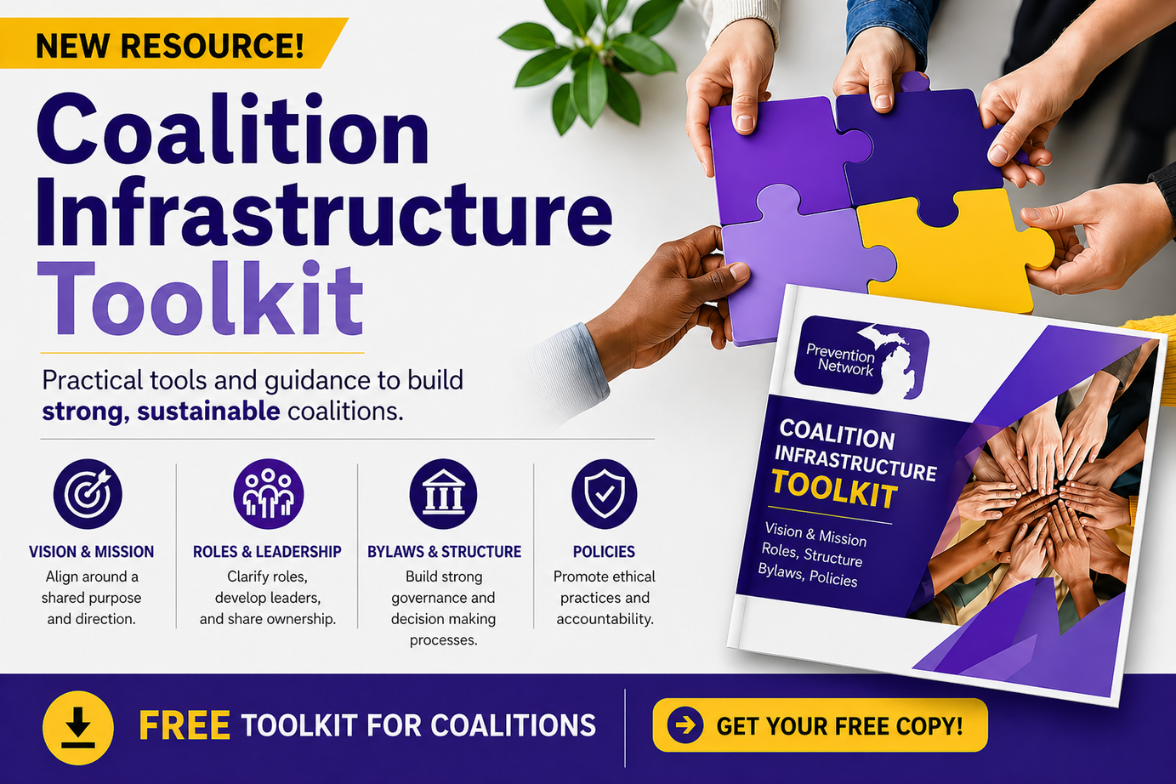
Hands place purple and yellow puzzle pieces over a Coalition Infrastructure Toolkit graphic, with a 'FREE TOOLKIT FOR COALITIONS' banner at the bottom and 'GET YOUR FREE COPY' callout.

NEW! FREE Resource
Coalition Infrastructure Toolkit

Prevention Network is rolling out a new resource, 2026 Coalition Infrastructure Toolkit, aligned with the MDHHS PFS–SPF workplan.

This free resource helps coalitions build strong, sustainable infrastructure with practical, customizable tools to clarify roles, strengthen governance, support ethical and financial accountability, and define a clear mission and vision.

This toolkit is designed to support coalitions at all stages of development in building strong, sustainable infrastructure. It provides practical tools and guidance to strengthen governance, clarify roles, and align coalition efforts around shared goals.

Coalitions may be in different phases of development—whether just forming, growing, or refining their work. This toolkit is intended to meet coalitions where they are and provide support along the way.

Leading Through Change: How Coalitions Can Stay Grounded and Move Forward

Change is something every coalition and prevention organization experiences—whether it’s staffing transitions, funding shifts, community challenges, changing priorities, or evolving public health trends. While change can feel overwhelming, it can also create opportunities for growth, stronger partnerships, and renewed focus.

Coalitions are uniquely positioned to help communities adapt during times of uncertainty because prevention work is built on collaboration, trust, and shared purpose. Strong coalitions continue moving forward by staying connected to their mission while remaining flexible in how they respond to emerging needs.

A few ways coalitions can lead effectively through change include:

  • keeping communication open and transparent with members and partners
  • revisiting goals and priorities regularly
  • focusing on relationship-building and community engagement
  • using local data to guide decisions
  • supporting member wellness and preventing burnout
  • celebrating progress, even small wins

Change does not always require a coalition to start over. Often, it is an opportunity to strengthen infrastructure, improve processes, and refocus efforts on what matters most to the community.

As prevention professionals continue navigating changing environments across Michigan, collaboration and adaptability remain essential tools for building healthy, resilient communities.

Resource Highlight: CADCA recently shared additional strategies on coalition leadership and navigating change. Their article reinforces the importance of flexibility, sustainability, and strong community partnerships in prevention work.

Source: CADCA


Behavioral Health Expansion Brings Opportunities—and Questions—for Prevention

The U.S. Department of Health and Human Services recently announced the addition of 10 states to the Certified Community Behavioral Health Clinic (CCBHC) Medicaid Demonstration Program, a model designed to expand access to mental health, substance use treatment, recovery supports, and crisis services.

Since launching in 2017, the CCBHC model has grown to more than 500 clinics nationwide, providing communities with increased access to coordinated behavioral health care and sustainable Medicaid funding. Supporters point to improved access to treatment, 24/7 crisis services, care coordination, and recovery supports as major benefits of the model.

At the same time, prevention professionals may note that much of the funding is directed toward treatment and crisis response rather than primary prevention efforts. As behavioral health systems continue to expand, it remains important to ensure that prevention strategies, youth-focused initiatives, and community-based prevention programs remain part of the conversation.

For preventionists, this announcement serves as a reminder that prevention, treatment, recovery, and crisis services are all part of a comprehensive behavioral health system. Looking ahead, opportunities may exist to strengthen partnerships between prevention providers and CCBHCs to better address community needs across the continuum of care.

Source: U.S. Department of Health and Human Services (HHS), Centers for Medicare & Medicaid Services (CMS), and Substance Abuse and Mental Health Services Administration (SAMHSA).

See the full calendar of events here.


Join Our Network

By joining our *no-cost* network, you will have exclusive access to:

  • A resource library filled with handouts, toolkits, templates, videos, and more
  • A forum to network with other coalitions
  • A map of other coalitions across the State.

Here’s how to use it:

  1. Go to https://www.preventionnetwork.org/resource-library/
  2. Type a keyword into the search bar (try a topic, program area, or content type).
  3. Open a resource to view, download, or save for later.

Whether you’re building a training, writing a grant, or looking for ready-to-use tools, the right resource is only a few clicks away.


Looking for Technical Assistance Support?

Prevention Network offers technical assistance (TA) to help strengthen and support your prevention efforts. Whether you’re planning, implementing, or refining your work, we can connect you with additional resources, tools, and guidance tailored to your needs. Technical assistance may include consultation calls, webinars, trainings, or ongoing support over time to address specific goals or challenges.

Learn more or request support: https://www.preventionnetwork.org/ta/


Upcoming PTTC Trainings for Prevention Professionals

Visit the PTTC Network’s training and events calendar to find upcoming prevention trainings and professional development opportunities available to the Great Lakes region. https://pttcnetwork.org/training-and-events-calendar/

The Prevention Network newsletter delivers timely and comprehensive state and national updates, covering the latest news, research findings, and best practices in the prevention field, ensuring you stay well-informed and equipped to address emerging challenges and opportunities in your prevention efforts. Check out some national and state updates below:


NATIONAL:

SAMHSA Expands Support for 988 Crisis Lifeline and Prevention Services

SAMHSA recently announced a $255 million award to continue administration of the 988 Suicide & Crisis Lifeline, helping ensure that individuals experiencing a mental health, substance use, or suicidal crisis can access immediate support 24/7 through call, text, chat, and videophone services.

Since launching in 2022, the 988 Lifeline has received more than 25 million contacts nationwide, highlighting the growing need for accessible behavioral health crisis services across communities, including here in Michigan.

In addition to supporting 988, SAMHSA announced more than $28 million in new funding opportunities focused on suicide prevention, youth mental health, substance use disorder treatment, and disaster crisis counseling.

For prevention professionals, coalitions, schools, and community partners, these investments continue to reinforce the importance of early intervention, prevention, and strengthening local behavioral health support systems.

If you or someone you know is struggling, call or text 988 or visit 988 Lifeline for confidential support.


STATE

Federal Funding Supports Michigan Public Health and Community Resilience Efforts

Michigan will receive approximately $3 million in new federal funding through FEMA to support COVID-19 response reimbursement efforts and infrastructure improvements aimed at reducing future public health and sanitation risks.

Funding will help reimburse healthcare systems, schools, and public agencies for pandemic-related emergency measures, while additional support will strengthen sanitation infrastructure in Macomb County to help prevent future sewer backups and community disruptions.

The announcement highlights the continued importance of investing in community resilience, emergency preparedness, and public health infrastructure — all key components in supporting healthier, safer communities across Michigan.

As prevention professionals continue addressing behavioral health, substance misuse, and community wellness, investments in long-term public health systems and local preparedness remain an important part of prevention-focused community planning.

Source: Detroit news


Thank you for reviewing Prevention Network’s newsletter! If you have any feedback regarding this newsletter or ideas for our next newsletter, please email us at info@preventionnetwork.org. Lastly, a special thanks to Prevention Network’s Board of Trustees for supporting our mission, vision, and goals.

Letter From the New Executive Director

Dear Prevention Providers,

With the weather warming up, I hope everyone is finding time to enjoy the outdoors and take a needed break from their offices and computers, after all, May is Mental Health Awareness month!

On the topic of mental health, I believe it is important to recognize that prevention work can be exhausting in the time and effort that is put into programs, in funding challenges, and in the constantly changing issues within the federal government. Burnout is real and quite prevalent in this field. The work that is done is often thankless and at times overwhelming. It takes a special type of person to work in the prevention field, one that is so determined to make a difference in their community that they sometimes put their own wellbeing to the side.

If no one else has told you lately, I see the work that you do and APPRECIATE all of the effort that you put into it. I also see the value in you as a person and encourage all prevention workers to take time for themselves and figure out coping strategies that work to reduce the stress that you may be experiencing.

It was nice to be able to meet with some of you at the MCRUD Annual Shoalition where there were amazing speakers and valuable information shared. It continues to surprise me (in the best way) all of the prevention work that is being done with local coalitions and school groups. I look forward to more in-person networking opportunities in the future where I can put faces to names and continue building strong relationships.

Thank you for all that you do!

Best,
Lauren Gonzales, MPH
Executive Director,
Prevention Network

Prevention Network is rolling out a new resource, 2026 Coalition Infrastructure Toolkit, aligned with the MDHHS PFS–SPF workplan. This free resource helps coalitions build strong, sustainable infrastructure with practical, customizable tools to clarify roles, strengthen governance, support ethical and financial accountability, and define a clear mission and vision.

Keep an eye on your inbox — this toolkit is coming soon.


SAMHAS 2026  Mental Health Awareness Month Toolkit

The toolkit launched May 1st.

Mental Health Awareness Month (MHAM) has been observed since 1949. For more than 20 years, SAMHSA has joined that tradition every May, raising awareness, sharing resources, and supporting the individuals and communities who need it most.

Check out what SAMHSA is doing, share our materials, and remember that we all play vital roles in caring for our mental health!

The Toolkit is a One-Stop Shop

The toolkit offers comprehensive resources in a central location that you can download and share. Some content can be customized for the needs of your audiences. The toolkit includes:

  • Key messages and themes for each week in May.
  • Social media content, graphics, and promotional materials designed for your audiences and media channels.
  • Messaging that encourages acceptance and support of people living with a mental illness.
  • Best practices for supportive and beneficial discussions about mental health.
  • Additional resources for increasing awareness about mental health in May and beyond.

How to Use the Toolkit Click Here


United Michigan Story Sharing Opportunity with Compensation

United Michigan is currently inviting individuals across the state who may be open to sharing their story around substance use disorder. We invite community members statewide to share their stories of recovery, resilience, and hope. Everyone’s journey matters, and each voice can inspire others who may be taking their first steps toward healing.

We understand that sharing something personal takes courage, and participation is completely voluntary and can be done in a way that feels comfortable for you. If you’re interested, we would truly value your voice and perspective.

Whether a story is about personal recovery, supporting a loved one, or making a difference in your community through work and advocacy, we want to hear from everyone! Together, we can highlight the strength, diversity, and courage of our Michigan communities and remind others that recovery is possible!


We compensate our story sharers $50 for their time and experience.


Are you or anyone you know Interested in sharing your story? Fill out the form below and help us amplify voices of hope across Michigan.

Interest Form


By sharing your story, you can help others feel seen, less alone, and supported as they navigate their own journey. Feel free to email Taylor Gassett, Senior Program Coordinator, National Stigma Initiative

Shatterproof: Stronger Than Addiction

E-Mail: tgassett@shatterproof.org

Shatterproof.org


New Tools to Measure Substance Use Disorder Knowledge in Your Community

A new resource from the Addiction Policy Forum is giving prevention professionals a practical way to better understand how communities think about substance use disorders (SUD).

Developed in partnership with the University of Delaware, two new validated tools—the Substance Use Disorder Prevention Knowledge Scale and the Substance Use Disorder Knowledge Scale—help measure what people actually know about prevention, treatment, and recovery.

Why it matters: stronger “addiction literacy” is directly linked to reduced stigma, better engagement in care, and more effective prevention efforts.

These free tools can help coalitions identify knowledge gaps, evaluate outreach efforts, and strengthen community education strategies.

Download the Scales                 Read the Study


NEWS RELEASE: Michigan Senators prioritize kids and tobacco prevention with approval of common-sense bills

Great News! This morning, the Senate passed bills repealing PUP penalties. These bills go hand-in-hand with bills that already passed the Senate requiring tobacco retailers to obtain a license.

Here’s the statement we issued applauding our Senators: “Repealing ineffective PUP penalties that hinder future opportunities for Michigan kids and instead holding retailers accountable is smart policy,” said Jodi Radke, regional director of the Campaign for Tobacco-Free Kids and chair of the Keep MI Kids Tobacco Free Alliance. “Combining this action with the effort requiring tobacco retailers to obtain a state-issued license would be a great win for kids’ health and tobacco prevention in Michigan. We are grateful to our Senate sponsors and urge the House to advance these bills without delay.”

Please thank our Senate sponsors for their continued partnership in protecting MI kids.

-Senator Paul Wojno (SenPWojno@senate.michigan.gov)

-Senator Mary Cavanagh (SenMCavanagh@senate.michigan.gov)

Full article

Bridging Alcohol & Cannabis Prevention: Key Takeaways from April 13’s Regulation Webinar

On April 13, prevention professionals from across Michigan came together for an important conversation on alcohol and cannabis regulation—and what it means for prevention efforts at the community level. The webinar brought together state regulators, industry representatives, and policy experts to provide a well-rounded look at how these substances are managed and where challenges remain.


A key takeaway was the critical role that regulation plays in prevention. Presenters from the Michigan Liquor Control Commission highlighted how licensing, compliance checks, and violation hearings help reduce risky practices like sales to minors. Similarly, cannabis regulatory leaders shared how Michigan’s evolving system—still relatively new compared to alcohol—continues to adapt to address issues like licensing, product safety, and consumer protection.


At the same time, industry representatives emphasized the importance of education and responsible practices, including clear labeling, packaging standards, and public awareness efforts aimed at preventing youth access. Discussions also raised emerging concerns, such as synthetic THC products and the impact of market saturation, reinforcing the need for ongoing policy refinement and community awareness.


One of the most valuable aspects of the webinar was the diverse perspectives at the table—from regulators and policymakers to industry and prevention professionals. This balanced dialogue highlighted that prevention is most effective when it includes multiple voices working toward a shared goal.


The takeaway is clear: as Michigan continues to navigate both alcohol and cannabis landscapes, prevention efforts must stay informed, adaptable, and connected to policy. Understanding how these systems operate helps coalitions and communities better respond to risks and support healthier outcomes.


April Alcohol Awareness Month in Michigan

This past April, communities across the country observed Alcohol Awareness Month, and Michigan coalitions and partners once again showed up in meaningful ways to raise awareness, promote prevention, and support healthier communities.


Coalitions Driving Local Impact: Throughout the month, prevention coalitions across Michigan led efforts to bring education and awareness directly into their communities—hosting workshops, engaging youth, and facilitating conversations around underage drinking and substance use.


A key example of this work was the 13th Annual Shoalition Showcase, hosted by the Michigan Coalition to Reduce Underage Drinking (MCRUD) on April 23 in Lansing. This full-day event brought together prevention professionals and coalition leaders from across Michigan for a full day of learning, collaboration, and connection. The event featured engaging sessions on topics including youth substance use trends, the role of alcohol in public safety, coalition partnerships with juvenile justice systems, and updates from the Michigan Liquor Control Commission. Attendees also explored practical strategies for building sustainable coalitions and strengthening prevention efforts at the community level. A highlight of the day was the opportunity to network and share successes during coalition exhibits and “Coalition Shout Outs,” reinforcing the importance of collaboration across the state. The event was a great success—bringing energy, insight, and renewed momentum to prevention efforts across Michigan.


Stay tuned for the 2027 Shoalition date.

See the full calendar of events here.


Join Our Network

By joining our *no-cost* network, you will have exclusive access to:

  • A resource library filled with handouts, toolkits, templates, videos, and more
  • A forum to network with other coalitions
  • A map of other coalitions across the State.

Here’s how to use it:

  1. Go to https://www.preventionnetwork.org/resource-library/
  2. Type a keyword into the search bar (try a topic, program area, or content type).
  3. Open a resource to view, download, or save for later.

Whether you’re building a training, writing a grant, or looking for ready-to-use tools, the right resource is only a few clicks away.


Looking for Technical Assistance Support?

Prevention Network offers technical assistance (TA) to help strengthen and support your prevention efforts. Whether you’re planning, implementing, or refining your work, we can connect you with additional resources, tools, and guidance tailored to your needs. Technical assistance may include consultation calls, webinars, trainings, or ongoing support over time to address specific goals or challenges.

Learn more or request support: https://www.preventionnetwork.org/ta/


Upcoming PTTC Trainings for Prevention Professionals

Visit the PTTC Network’s training and events calendar to find upcoming prevention trainings and professional development opportunities available to the Great Lakes region. https://pttcnetwork.org/training-and-events-calendar/

The Prevention Network newsletter delivers timely and comprehensive state and national updates, covering the latest news, research findings, and best practices in the prevention field, ensuring you stay well-informed and equipped to address emerging challenges and opportunities in your prevention efforts. Check out some national and state updates below:


STATE & NATIONAL:

National Update: What CADCA’s Latest Insights Mean for Prevention in Michigan

Recent updates from Community Anti-Drug Coalitions of America are reinforcing a familiar message—with more urgency: strong, sustainable coalitions are essential in today’s shifting prevention landscape.

Nationally, CADCA continues to emphasize the Strategic Prevention Framework (SPF)—grounding prevention in data, partnerships, and long-term planning rather than one-time efforts.

What This Means for Michigan

Michigan is already aligned with these priorities through work supported by the Michigan Department of Health and Human Services and local coalitions. The expectation now is to strengthen that foundation by clearly demonstrating impact.

For coalitions, that means:

  • Using local data to guide decisions
  • Strengthening cross-sector partnerships
  • Focusing on measurable, long-term outcomes

Rising Expectations

With federal funding less predictable, prevention efforts are under greater scrutiny. Coalitions that can show real results—like reduced youth substance use and stronger community conditions—will be better positioned to sustain support.

Emerging Challenges

CADCA also points to growing complexity in the field, including:

  • Youth mental health and substance use
  • Emerging drug trends
  • Changing policy environments


The playbook hasn’t changed—but expectations have.

Michigan’s foundation is strong. The focus now is on proving impact, strengthening partnerships, and staying adaptable in a prevention landscape that continues to evolve.

Thank you for reviewing Prevention Network’s newsletter! If you have any feedback regarding this newsletter or ideas for our next newsletter, please email us at info@preventionnetwork.org. Lastly, a special thanks to Prevention Network’s Board of Trustees for supporting our mission, vision, and goals.
Letter From the New Executive Director

Hello Prevention Community,

Happy spring! These first few months as Executive Director have flown by! I wanted to start by thanking everyone for the advice, wisdom, and well wishes that have been bestowed on me as I have stepped into this new position. The communication and closeness of the prevention community is something that I have always appreciated. 

Here at Prevention Network things have been moving at an upward trajectory. The wonderful PN staff have been putting in the work to make our substance misuse prevention programs successful. Last month, with March being Parenting Awareness month in our state, the spotlight was put on our Parenting Awareness Michigan (PAM) program. Many resources were shared to benefit parents, guardians, and caretakers. One of the events that Prevention Network was able to host was in partnership with Partnership to End Addiction, where we hosted an in-person training focusing on raising strong and resilient children. I wanted to give a special thank you to Representative Stephanie Young who attended this event, shared her insight into the importance of substance misuse prevention, and made herself available for a community conversation. 

Moving forward, all of our programs have great events coming up and we continue to create and distribute resources to aid in the substance misuse prevention work here in Michigan. I continue to have high hopes for Prevention Network and hope that in the near future we can expand on partnerships and work that we are able to do throughout the state.  

I hope you all are able to have a peaceful, renewing spring, and continue all of the great work that is being done for substance misuse prevention. 

Best,
Lauren Gonzales, MPH
Executive Director,
Prevention Network

2026 Annual CMH-CEI Community Event on March 23rd

CMHA-CEI’s annual community event, centered on this year’s theme “Hope Grows Here,” was a meaningful start to the day and a strong reminder of the impact happening across our community.

Guests were welcomed by the sounds of the MSU Jazz Quintet, whose music created a warm and inviting atmosphere as attendees gathered. At our table, we found ourselves appreciating the moment—connecting, reflecting, and easing into the program in a way that felt both intentional and uplifting.

The program itself highlighted both partnership and progress. NAMI Lansing was recognized for its continued leadership in mental health advocacy, with the keynote from Kevin Fischer underscoring the organization’s vital role in supporting individuals and families across the region.

One of the most memorable moments of the morning was the recognition of Sara Lurie, who announced her retirement after 30 years as Chief Executive Officer of CMHA-CEI. It was a moment of both celebration and reflection. I couldn’t help but think back to Sara’s time serving on Prevention Network’s Board—her leadership and dedication made a lasting impact on our organization as well.

Her career has shaped this community in ways that are difficult to fully capture. The systems strengthened, the partnerships built, and the countless lives touched stand as a testament to her leadership.

The unveiling of the annual report brought everything together—highlighting not only key milestones, but the continued commitment to innovation, collaboration, and inclusive care. It was clear that the work is not slowing down—it’s evolving to meet the growing needs of the community.

If there was one takeaway from the morning, it’s this: hope isn’t just a message—it’s something being actively built every day.

Mental Health Awareness: Support Starts with a Conversation

Mental health is just as important as physical health—and it affects individuals, families, and communities across Michigan. Mental Health Awareness is a reminder that no one has to navigate challenges alone. Whether someone is experiencing stress, anxiety, depression, or simply needs someone to talk to, support is available.

Stigma around mental health can often prevent people from seeking help. By normalizing conversations and showing support, we can create spaces where individuals feel safe reaching out and accessing the care they need. A simple check-in with a friend, coworker, or loved one can go a long way in reducing isolation and building connection.

If you or someone you know needs support, free and confidential resources are available:

Reaching out is a sign of strength. Together, we can reduce stigma and build healthier, more supportive communities across Michigan.


Children Trust Michigan Leads the Way in Child Abuse Prevention

Each April, Children Trust Michigan leads the state’s recognition of Child Abuse Prevention Month, highlighting the importance of supporting families before challenges turn into crises.

As Michigan’s designated child abuse prevention organization, Children Trust Michigan invests in community-based programs and Family Resource Centers that provide essential supports to families across all 83 counties. These include access to basic needs like food, diapers, and safe sleep resources, along with parenting education, early childhood development, and connections to local services.

While these supports may seem simple, they play a critical role. By reducing family stress, increasing protective factors, and strengthening connections, these programs help prevent neglect and abuse before it occurs.

Throughout April, Children Trust Michigan encourages communities to take part by sharing the Governor’s Proclamation and participating in National Wear Blue Day, a visible show of support for safe, stable, and nurturing families.

Child abuse prevention starts with all of us—but it’s efforts like these that make a lasting impact. When families are supported, children—and communities—thrive

Learn More

To Report Child Abuse or Neglect Call 855-444-3911


Michigan Overdose Prevention Coalition (MOPC)

The Michigan Overdose Prevention Coalition (MOPC) is offering a series of free, public learning opportunities focused on harm reduction and overdose prevention across Michigan. These sessions provide practical insights into why harm reduction matters and how communities can take action to address the opioid crisis.

MOPC also offers recorded webinars on advocacy and working with the media, giving prevention professionals and community members tools to strengthen their impact. With overdose continuing to affect communities statewide, these resources support efforts to reduce stigma, expand access to lifesaving strategies, and promote healthier communities.


Did You Know? One Vape Can Equal Hundreds of Cigarettes

Coalitions across Michigan are using innovative, hands-on displays to help communities better understand the impact of vaping. By comparing the nicotine content in a disposable e-cigarette to traditional cigarettes, these visuals bring awareness to how much nicotine a single device may contain.

In some cases, one disposable vape can equal over 200–300 cigarettes, depending on the product size and nicotine concentration. This estimate is based on calculations used by researchers at Stanford Medicine REACH Lab, which compare the total nicotine in a vape to the average amount absorbed from a traditional cigarette.

For example:

  • A typical disposable vape may contain 5% nicotine (50 mg/mL) × ~5–6 mL of liquid = 250–300 mg of nicotine total
  • Divided by ~1 mg absorbed per cigarette = 250–300 cigarettes worth of nicotine

Coalitions can use replica materials and tailor comparisons based on products commonly seen in their communities. Whether used in classrooms, community events, or prevention presentations, this approach helps spark meaningful conversations and supports informed decision-making.


Cannabis Awareness & Prevention Toolkit

Stanford REACH Lab, Theory-based and evidence-informed resources created by educators, parents, and researchers aimed at preventing middle and high school students’ use of cannabis/marijuana.

at stanfordreachlab@stanford.edu.


Huge study finds no evidence cannabis helps anxiety, depression, or PTSD

The largest review of medicinal cannabis to date found it doesn’t effectively treat anxiety, depression, or PTSD—despite millions using it for those reasons. Researchers warn it could even make mental health worse, raising risks like psychosis and addiction while delaying proven treatments. Some limited benefits were seen for conditions like insomnia and autism, but the evidence is weak. The findings are fueling calls for stricter oversight as cannabis use continues to rise.

University of Sydney. www.sciencedaily.com/releases/2026/03/260319044656.h


Tobacco Prevention Toolkit!

This Tobacco Prevention Toolkit, developed by the Stanford REACH Lab, is comprised of a collection of curriculums, lessons, programs, and resources catered to prevent and reduce adolescent and young adult tobacco/nicotine use. While there are some crossovers between our toolkits, our intent is to keep everything packaged and easy for educators, parents, and the like to navigate our resources.

For any questions or concerns please contact us directly at stanfordreachlab@stanford.edu.


Mini-Grant Opportunity from Tobacco-Free Michigan

Deadline to submit is May 1, 2026

Tobacco-Free Michigan is offering mini-grants to members and partners for projects to reduce the disparity in tobacco impact between different ethnic/demographic groups, engage youth in the tobacco free movement, increase public awareness of ENDS or serve as a pilot for a project that could reduce the impact that tobacco has on the public health of your community. The maximum request that will be considered is $10,000. All money must be spent by September 30, 2026.


Applications can be found here.

See the full calendar of events here.


Join Our Network

By joining our *no-cost* network, you will have exclusive access to:

  • A resource library filled with handouts, toolkits, templates, videos, and more
  • A forum to network with other coalitions
  • A map of other coalitions across the State.

Here’s how to use it:

  1. Go to https://www.preventionnetwork.org/resource-library/
  2. Type a keyword into the search bar (try a topic, program area, or content type).
  3. Open a resource to view, download, or save for later.

Whether you’re building a training, writing a grant, or looking for ready-to-use tools, the right resource is only a few clicks away.


Looking for Technical Assistance Support?

Prevention Network offers technical assistance (TA) to help strengthen and support your prevention efforts. Whether you’re planning, implementing, or refining your work, we can connect you with additional resources, tools, and guidance tailored to your needs. Technical assistance may include consultation calls, webinars, trainings, or ongoing support over time to address specific goals or challenges.

Learn more or request support: https://www.preventionnetwork.org/ta/


Upcoming PTTC Trainings for Prevention Professionals

Visit the PTTC Network’s training and events calendar to find upcoming prevention trainings and professional development opportunities available to the Great Lakes region. https://pttcnetwork.org/training-and-events-calendar/

The Prevention Network newsletter delivers timely and comprehensive state and national updates, covering the latest news, research findings, and best practices in the prevention field, ensuring you stay well-informed and equipped to address emerging challenges and opportunities in your prevention efforts. Check out some national and state updates below:


STATE:

Prevention Is No Longer Standalone: A Shift Toward Whole-Person, Community-Based Approaches

Prevention work has evolved. While education and awareness remain important, today’s challenges make one thing clear: prevention can no longer operate in isolation.

Substance use and mental health are closely tied to broader factors like trauma, housing stability, and access to coordinated care—often referred to as the social determinants of health. Research from the SAMHSA shows that these conditions significantly influence both risk and recovery outcomes. Individuals experiencing housing instability, for example, are at much higher risk for substance use and mental health challenges, while stable housing supports long-term recovery.

At the same time, trauma-informed approaches are becoming the standard. Experiences such as adverse childhood events (ACEs), chronic stress, and community violence shape how individuals cope—often driving substance use if left unaddressed.

As a result, national efforts are shifting toward integrated, cross-system strategies that bring together behavioral health, housing, education, and community services. This approach reflects a growing understanding that prevention must address the full picture—not just individual behavior.

What This Looks Like in Michigan

Across Michigan, this shift is already underway:

  • Community Mental Health (CMH) agencies are expanding integrated behavioral health services
  • Coalitions are partnering with schools to address youth mental health and early intervention
  • Communities are investing opioid settlement funds into treatment, recovery, and alternative programs like drug courts
  • Harm reduction strategies—such as naloxone distribution and safe storage—are becoming more widely accepted

For prevention professionals, the message is clear: The most effective work today connects systems, builds partnerships, and addresses root causes—not just symptoms.

This evolution may feel complex, but it also creates new opportunities to strengthen communities, improve outcomes, and ensure prevention efforts are more impactful than ever before.


NATIONAL:

SAMHSA Announces More Than $69 Million in Funding Opportunities for Serious Mental Illness and Suicide Prevention Grant Programs

On March 6, 2026, the Substance Abuse and Mental Health Services Administration (SAMHSA), part of the U.S. Department of Health and Human Services (HHS), announced $69.1 million in new funding opportunities aimed at strengthening mental health services, expanding suicide prevention efforts, and increasing access to treatment for individuals living with serious mental illness.

These investments support three key grant programs that reflect where the field is heading: earlier intervention, stronger systems of care, and a continued emphasis on evidence-based approaches.

The largest portion—$43 million—will fund the Children’s Mental Health Initiative (CMHI), which focuses on building comprehensive, community-based systems of care for children, youth, and young adults (birth through age 21) experiencing serious emotional disturbances. This includes efforts to identify youth earlier and provide support not only to individuals, but to families as well.

An additional $16.1 million will support the Zero Suicide initiative, an evidence-based framework designed to help healthcare systems prevent suicide among individuals in their care. This approach reinforces a growing national priority: treating suicide as preventable through coordinated, system-wide strategies.

The remaining $10 million will fund Assisted Outpatient Treatment (AOT) programs, which provide structured, community-based treatment options for adults with serious mental illness who meet specific criteria. These programs are designed to improve stability, increase treatment engagement, and reduce cycles of crisis.

Together, these funding opportunities align with broader national efforts to strengthen prevention, expand treatment access, and address the root causes of substance use and mental health challenges—including housing instability and untreated mental illness.

For prevention professionals, this announcement reinforces a clear direction: the future of prevention is integrated, data-driven, and rooted in early intervention and cross-system collaboration. Programs that connect mental health, substance use prevention, and community partnerships will continue to be prioritized.

If you or someone you know is struggling, help is available. Call or text 988, or visit 988lifeline.org. To find local treatment options, visit FindTreatment.gov.

Thank you for reviewing Prevention Network’s newsletter! If you have any feedback regarding this newsletter or ideas for our next newsletter, please email us at info@preventionnetwork.org. Lastly, a special thanks to Prevention Network’s Board of Trustees for supporting our mission, vision, and goals.

Letter From the New Executive Director

Hello Prevention Community,

I am happy to be stepping into the role of Executive Director at Prevention Network!

Here’s a little about me first- I graduated from Alma College with a bachelors in biology and continued my education at Central Michigan University where I got my masters degree in Public Health. I live in Dewitt with my significant other and our 2 cats Junebug and Cricket. In my free time I love to read, hike, travel, spend time with my large family, and do anything artsy. I am a strong advocate for public health, changing outcomes, and making the world a better place for the next generation.

I have worked at Prevention Network for almost 2 years. I started as the Michigan Youth Coalition Network (MYCN) Coordinator, when ARPA funding was discontinued I moved into the role of Coalition Program Coordinator where I coordinated various projects under the PFS grant.

As I step into the role of Executive Director I hope to set a tone of positivity and collaboration for Prevention Network. Growing up my dad had many dadisms that I have lived my life by, I was often told “squeaky wheel gets the oil” meaning if you want something you need to speak up, and another favorite was always telling me that within collaborations you’re only as successful as who you hitch your wagon to. I hope that Prevention Network can continue to be a reliable

organization to “hitch your wagon to”, and that if any one in the prevention community needs help we can be “the oil for your squeaky wheel”.

I have a lot of high hopes and goals for this organization and none of our success will be possible without the partnerships and outreach that we currently have and hope to expand on. I am positive that the change that I can bring to this organization will be a positive one, and I look forward to continuing the important work of prevention. Please feel free to reach out to me at any time, my email is always open and I’m always looking for more connections!

Lauren Gonzales, MPH
Executive Director,
Prevention Network

Update on Michigan’s Mental Health System

Positive Developments in Michigan’s Mental Health System

Good news for the moment: Earlier this year, Michigan halted its proposed overhaul of the state’s mental health system, withdrawing plans that would have significantly restructured how Medicaid-funded behavioral health services are managed.

After legal concerns were raised, the state canceled its call for proposals and paused the bid-out process. This decision helps1preserve stability for community-based mental health providers and the people they serve, while creating space for more thoughtful and collaborative conversations about system improvements.

For those who want to read more, here are two recent articles that outline what happened:

While broader reform discussions are expected to continue, this pause is a positive development for local oversight and continuity of care. We’ll keep monitoring state-level prevention and mental health policy updates and share new information as it becomes available.


New Drug is Driving a Dangerous Withdrawal Crisis

A powerful veterinary sedative most people have never heard of is rapidly reshaping the overdose crisis—and it’s not showing up the way we expect. According to a new report from The New York Times, medetomidine is increasingly appearing in the illicit fentanyl supply, triggering severe, life-threatening withdrawal rather than immediate overdose. Hospitals in Philadelphia are seeing a surge in emergency visits, many requiring intensive care, as people experience extreme symptoms from a drug they didn’t knowingly use. With medetomidine now detected beyond Philadelphia, this emerging trend raises urgent questions for prevention, treatment, and policy nationwide.

Read more to understand why this matters—and why systems need to adapt fast.

Source: Addiction Policy Forum


Message Matters

Substance Use Prevention Communications Toolkit

Effective prevention starts with how we communicate. Messages that are grounded in prevention science and thoughtfully framed are more likely to resonate with youth, families, and communities—and to support healthier norms around substance use.

The Substance Use Prevention Communications Toolkit, developed by the Prevention Technology Transfer Center (PTTC) Network, offers practical, evidence-informed guidance for communicating with youth ages 12–18. The toolkit includes strategies for message framing, language choices, and approaches for shifting community mindsets to support prevention.

As you plan outreach for SAMHSA Prevention Week, Prevention Month, and year-round prevention efforts, this toolkit can support stronger, more effective communications.

Explore the Toolkit:

Check out the Toolkit!


Source: Prevention Technology Transfer Center (PTTC) Network


Kratom in Michigan:

State Bill Introduced, Local Rules Emerging

Kratom remains legal statewide in Michigan — but legislative activity and local regulations are beginning to shift the landscape.

In February 2026, lawmakers introduced a bipartisan bill that would ban the growth and sale of kratom in Michigan. The proposal would make selling or growing kratom a misdemeanor, with enhanced penalties for sales to minors. The bill has been referred to the House Committee on Regulatory Reform.

At the local level, Clinton Township has adopted what appears to be Michigan’s first kratom ordinance. The policy restricts sales to individuals 21 and older, requires retail signage, and enforces violations through township police. The Cities of Warren and Southfield are also discussing similar measures.

Additionally, HB 4969 proposes a statewide consumer protection framework, which could reduce the development of inconsistent local ordinances.


Sources: https://www.wilx.com/2026/02/20/new-bill-would-ban-growth-sale-kratom-michigan/;

https://www.wxyz.com/news; MI HB4969; and Bridge Michigan/news


Prevention Data Spotlight: Youth Substance Use Remains Low

New data from the Monitoring the Future Study, led by the National Institute on Drug Abuse and the University of Michigan, show adolescent substance use remains near historic lows in 2025. High rates of abstinence among 8th, 10th, and 12th graders continue to reflect the long-term value of prevention, education, and community-driven strategies.

Check Out Johnny’s Ambassadors’ 2026 Youth THC Prevention Video PSA Contest

Johnny’s Ambassadors is sponsoring a Video PSA Content demonstrating the importance of preventing cannabis/THC use (vaping, dabbing, marijuana, edibles) among high school students. Help get the word out by providing education on why THC is harmful for the developing brain, mental health, and your life!

The contest ends on April 13, 2026 and winners will receive cash prizes.

Learn More


Prevention Data Spotlight: Youth Substance Use Remains Low

New data from the Monitoring the Future Study, led by the National Institute on Drug Abuse and the University of Michigan, show adolescent substance use remains near historic lows in 2025. High rates of abstinence among 8th, 10th, and 12th graders continue to reflect the long-term value of prevention, education, and community-driven strategies.


Updated Dietary Guidelines Offer More Restrictive Guidance on Alcohol Use

The U.S. Department of Health and Human Services (HHS) and the U.S. Department of Agriculture (USDA) released updated Dietary Guidelines for Americans that revise federal guidance on alcohol consumption. The guidelines remove specific daily drink limits and instead advise Americans to “consume less alcohol for better overall health.”

Previous federal guidelines included specific thresholds, recommending that adults 21 years and older consume no more than two drinks per day for men and one drink per day for women. The new guidelines do not include numerical limits and no longer differentiate guidance by gender, despite research showing that men and women metabolize alcohol differently.

Major health authorities have consistently reported that alcohol consumption increases health risks over time, even at lower levels.

Read More

See the full calendar of events here.


Upcoming PTTC Trainings for Prevention Professionals

Visit the PTTC Network’s training and events calendar to find upcoming prevention trainings and professional development opportunities available to the Great Lakes region. https://pttcnetwork.org/training-and-events-calendar/

The Prevention Network newsletter delivers timely and comprehensive state and national updates, covering the latest news, research findings, and best practices in the prevention field, ensuring you stay well-informed and equipped to address emerging challenges and opportunities in your prevention efforts. Check out some national and state updates below:


STATE:

Prevention Update: What Michigan Communities Should Be Watching 2026

Substance use prevention remains a priority in Michigan, supported by continued state investment and strong prevention infrastructure. More than $131 million in opioid settlement funds are being directed toward prevention, harm reduction, treatment, recovery, and workforce development, strengthening community capacity across the state. These investments support local coalitions and partners working to implement evidence-based strategies and sustain prevention efforts long term.

Michigan continues to emphasize data-driven planning and the Strategic Prevention Framework (SPF). State tools such as MDHHS prevention reports and the Michigan Substance Use Disorder Data Repository help communities assess needs, track trends, and guide effective decision-making, reinforcing a coordinated and evidence-informed approach to prevention statewide.

Sources: MDHHS (michigan.gov/mdhhs) | Michigan Opioid Healing & Recovery Fund (michigan.gov/opioids) | MI-SUDDR (mi-suddr.com)

NATIONAL:

National Federal Prevention Update: Funding Restored, Stability Still at Risk

In mid-January, the White House reversed a proposed $2 billion cut to federal addiction, overdose prevention, and mental health grants after swift pushback from lawmakers and providers nationwide.

Earlier that week, Substance Abuse and Mental Health Services Administration (SAMHSA) grantees were notified their grants would be terminated immediately, citing “non-alignment with priorities.” By Wednesday evening, the administration rescinded the terminations following intervention at the White House.

The reversal comes as national overdose deaths begin to decline—reinforcing the importance of sustained, evidence-based prevention and treatment investments. While funding is restored for now, the episode raised serious concerns about funding stability and planning at the community level.

Why This Matters for Preventionists

  • Funding volatility is real: Even long-standing grants can be disrupted with little notice.
  • Prevention works: Declining overdose deaths and low youth use rates underscore the impact of sustained prevention efforts.
  • Planning requires caution: Programs may need contingency plans as federal priorities shift.
  • Advocacy matters: Rapid response from the field helped reverse these cuts—continued engagement is critical.

Thank you for reviewing Prevention Network’s newsletter! If you have any feedback regarding this newsletter or ideas for our next newsletter, please email us at info@preventionnetwork.org. Lastly, a special thanks to Prevention Network’s Board of Trustees for supporting our mission, vision, and goals.

Letter From the Executive Director

Dear Prevention Providers,

As we begin to wind down the year, I am reminded of this quote by Lao Tzu, “The journey of a thousand miles begins with one step.” This past year included many changes at Prevention Network from gaining new staff, developing valuable partnerships, and rekindling past collaborations. We made changes to improve our internal processes to deliver streamlined services to our partners. While we acknowledge there have been language changes at the federal level, who we serve and what we do remains at the heart and core of our existence. At times it was challenging, but with each step we got closer to achieving our goals.

The resources and information you will see throughout this newsletter include ones shared with our Board at our fall retreat and with various partners serving the unique needs of communities. We hope these are valuable as you engage in developing solutions and evidence-based practices.

We look forward to the new year with renewed optimism, continued improvement, and hope for better things to come in 2026. We are grateful for your support and stepping alongside us throughout this journey.

To your continued health and well-being,

Rashmi Travis, MPH, CHES, CPS
Executive Director,
Prevention Network

Coalition Development Program

2026 PFS Subawards-As part of the Strategic Prevention Framework Partnership for Success grant / Michigan Partnership to Advance Coalitions project (PFS/MI-PAC), Prevention Network (PN) via its Coalition Training and Technical Assistance Program is offering $3,000 sub-awards to six coalitions to increase capacity for communities with high substance use risk to identify and address tobacco, e-cigarettes, and cannabis issues.

Application information will be available January 1, 2026.

Virtual Q&A sessions will be held on:

Session 1: January 15, 2026, 11 AM – 12 PM EST
Session 2: January 22, 2026, 4 PM – 5 PM EST

If you are unable to attend, please email Program Coordinator, Lauren Gonzales, laureng@preventionnetwork.org with your questions.

The Youth Coalition Toolkit is now available on Prevention Network’s website. This guide aims to inform about starting and sustaining youth coalitions. To access the toolkit as well as many other amazing resources and our interactive coalition map you need to become a member. Membership is FREE, to become a member follow the directions at this link:

New Coalition Coordinator training in development! Prevention Network is working on developing a training for new coordinators starting in the prevention field- these trainings will be for individuals who have been in the prevention field for less than a year and want to learn the basics of becoming a successful coordinator. Stay tuned for more information!

MYCN meetings are every third Tuesday of the month, 11:30 a.m.-12:00 pm! Join Zoom Meeting link: MYCN Monthly Zoom Meeting
Zoom Link

Parenting Awareness Michigan (PAM) is getting ready for Parenting Awareness Month 2026—and we’d love your help!

March is right around the corner, and PAM is inviting partners across Michigan to share local parenting and family-focused activities for the 2026 PAM Local Activities Calendar. Whether it’s a workshop, family fun night, support group, or virtual event, every activity plays a role in strengthening families, supporting prevention, and connecting parents and caregivers to meaningful resources. PAM is also planning a special prevention-focused event in early March in collaboration with Partnership to End Addiction—details coming soon. And be sure to save the date for the 34th Annual Parenting Awareness Michigan Conference on November 9, 2026 (location to be announced).

👉 Submit an activity or learn more here: Submit an activity today!

SAVE THE DATE: 34th Annual PAM Conference
Monday, November 9, 2026 Location: TBA

Contact Kaylee Singer for PAM and MIHEN at kaylee@preventionnetwork.org

(MIHEN) supports prevention efforts on college and university campuses across Michigan by connecting higher ed professionals to timely resources, research, and peer collaboration.

Through regular network meetings, shared public health research, and one-on-one engagement, MIHEN helps campuses address substance use prevention topics like impaired driving, alcohol and cannabis use, and student well-being. The program also strengthens communication across institutions by maintaining a trusted network of key campus contacts, ensuring prevention professionals can easily connect, share strategies, and support one another.

👉 Learn more about MIHEN and how to get involved:https://www.preventionnetwork.org/mihen

Contact Kaylee Singer for PAM and MIHEN at kaylee@preventionnetwork.org.

Mark your calendar — the next MCRUD General Meeting will take place on January 27 at 9:00 AM. We’ll be sharing updates and looking ahead to key initiatives for 2026.

Plans are also underway for the MCRUD Annual Conference on April 23 at Peckham in Lansing. A call for speaker proposals and conference registration will be opening soon — stay tuned for details.

Additional updates coming your way include information on the MCRUD Mentoring Program, membership opportunities, and the launch of an upcoming PhotoVoice project. April is also Alcohol Awareness Month, and we’re preparing resources and activities to support local prevention efforts.

Finally, a policy forum on alcohol and cannabis regulation in Michigan is tentatively scheduled for March 9. More information will be shared as plans are finalized.

Contact Mike Tobias, MCRUD Coordinator at miket@preventionnetwork.org.

As we move into the coming year, it’s important to remember that help and support are available for individuals, families, and communities impacted by substance use and overdose. Whether you’re looking for prevention resources, treatment options, recovery supports, or overdose prevention information, PDO partners continue to connect people to life-saving tools and services.

Resources include information on recognizing warning signs, accessing treatment and recovery supports, overdose prevention education, and naloxone availability across Michigan. Prevention Network’s PDO program also highlights trusted state and national resources to help communities stay informed, prepared, and supported in the year ahead. List of resources here.

Contact Ieshia Dawson, PDO Coordinator at Ieshiad@preventionnetwork.org.

Empowering Families: The Power of Prevention Programs

Highlights & Practical Tools You Can Use

One of many of our standout workshops at the PAM Conference in November was—Empowering Families: The Power of Prevention Programs, presented by Barry Schmidt (Bay Arenac ISD)—reminded us how essential parents and caregivers are to strong prevention work. Barry highlighted practical, evidence-based programs that strengthen families, build resilience, and support youth well-being.

This is great information for preventionists and the many partners we work with, especially those supporting families directly in schools, coalitions, and community organizations.

📥 Download the full presentation here

📚 Access the shared resources here

Alcohol/Cannabis Misuse Trends by Youth & Prevention

Highlights & Practical Tools You Can Use

One of many of our standout sessions at the MCRUD Meeting—Youth Alcohol & THC Misuse Trends presented by Denise Kolakowski (Michigan Poison & Drug Information Center, Wayne State University)—which highlighted the real-time data we’re seeing among Michigan youth. Denise walked through the steady rates of alcohol-related poison exposures, the rise in co-occurring alcohol and THC use, and the serious health effects that follow, from impaired decision-making to medical complications.

Youth alcohol & THC.2025

This is great information for preventionists and the many partners we work with, especially those supporting youth in schools, coalitions, healthcare settings, and community organizations.

📥 Download the full presentation here

📚 Access the shared resources here

Opioid Overdose Prevention and Narcan Training

Highlights & Practical Tools You Can Use

One of two presentations at the PN Board Retreat—Opioid Overdose Prevention, presented by Tammy Maidlow-Bresnahan (Ingham County Health Department)—which walked us through how opioid overdoses happen, the key risk factors, and the life-saving role of naloxone. Tammy broke down the four “waves” of the opioid crisis, shared local Ingham County data, and addressed common myths while emphasizing the power of person-first, stigma-free language.

This is great information for preventionists and the many partners we work with, especially those supporting individuals and families at risk, providing education, or connecting people to treatment and community resources.

📥 Download the full presentation here

Harm Reduction

Highlights & Practical Tools You Can Use

One of two presentations at the PN Board Retreat—Harm Reduction presentation – Sarah Landes and Nicholas Miller, (MDHHS, Harm Reduction Pillar Epidemiologist

Viral Hepatitis Epidemiology Unit )—who provided an in-depth overview of syringe service programs (SSPs), statewide harm-reduction data, recent modeling results, and Michigan’s FY 2026 opioid settlement investments.

This is excellent information for preventionists, coalition leaders, and community partners working to strengthen harm-reduction strategies and understand Michigan’s evolving landscape of opioid response and investment.

While their slide deck cannot be shared due to pending communications review, MDHHS has released public resources that contain the same approved information for partners and preventionists to access:

SSP 101: https://www.michigan.gov/mdhhs/keep-mi-healthy/mentalhealth/drugcontrol/syringe-service-programs/ssp-101

Harm Reduction Data: https://www.michigan.gov/mdhhs/keep-mi-healthy/mentalhealth/drugcontrol/syringe-service-programs/data-and-stats/data-statistics

Harm Reduction Modeling Results (includes 1-pager): https://www.michigan.gov/mdhhs/inside-mdhhs/newsroom/2025/09/25/harm-reduction

FY 2026 Opioid Settlement Investments: https://www.michigan.gov/mdhhs/inside-mdhhs/newsroom/2025/11/06/opioids-budget

Michigan Resources for Problem Gambling

Since the 2018 U.S. Supreme Court decision that lifted the federal ban on sports betting, states across the country—including Michigan—have rapidly expanded access to gambling. With online casinos and sports betting now fully legal here, gambling has never been easier to participate in… or harder to avoid.

As gambling opportunities grow, so do concerns about problem gambling and gambling disorder. Early data suggests that gambling participation is rising nationwide, and Michigan’s own trends reflect this shift. Behavioral-health systems, prevention programs, and community coalitions are increasingly being called on to respond. Read full the full brief examining problem gambling and behavioral health systems. Learn where Michigan is is in the helping.

  • 24/7 Helpline — 1-800-GAMBLER
    Confidential support, screening, and referral to treatment anywhere in Michigan.
  • MDHHS Gambling Treatment Program
    State-funded counseling for individuals and families. Services available through local CMH agencies and approved providers statewide.
  • Michigan Gaming Control Board (MGCB) Responsible gaming tools, self-exclusion program, and public awareness campaign “Don’t Regret the Bet.”
  • Online Self-Help & Education
  • don’tregretthebet.org
  • michigan.gov/problemgambling
  • ncpgambling.org
  • Need Local Support?
    Michigan offers a full directory of treatment providers by county—useful for coalitions, clinicians, and community partners.

Community Health Improvement Plan (CHIP) Update

On December 16, I attended the ISAP Holiday Celebration, where they outlined the Community Health Improvement Plan (CHIP). The CHIP is a strategic, community-driven roadmap that uses data from the Community Health Assessment (CHA) to guide collective action aimed at improving population health across the region.

The newly released 2025–2027 CHIP outlines shared priorities and coordinated strategies developed in partnership with health departments, community organizations, healthcare systems, schools, and other local stakeholders. This cycle focuses on three key priority areas: Access to Care, Behavioral Health, and Housing. The plan reinforces the importance of collaboration and shared responsibility, recognizing that meaningful and lasting impact happens when communities work together toward common goals.

Visit the Ingham County Health Department website to view the full 49 page plan.

Contact: Barry-Eaton District Health Department Lauren Metcalfe · lmetcalfe@bedhd.org · (517) 541-2624; Ingham County Health Department Kara Trimbach Shirley · kshirley@ingham.org · (517) 328-8778; Mid-Michigan District Health Department Liz Braddock · lbraddock@mmdhd.org · (989) 831-3610

This section highlights upcoming events such as webinars, conferences, and workshops, providing you with valuable opportunities to engage with experts, learn new strategies, and network with peers, ultimately fostering collaboration and advancing knowledge in the prevention field. Check out events coming up in the below:

  • Quarterly Coalition Support & Networking Meetings
    Prevention Network is hosting virtual gatherings designed for coalition leaders and members to gain answers, inspiration, and connections. All meetings begin at 12:00 PM. Dates and the Zoom link can be found on the website, and upcoming meetings include March 11, June 17, and September 8. More information is available here.
  • 2026 PFS Subawards Application
    As part of the Strategic Prevention Framework Partnership for Success / Michigan Partnership to Advance Coalitions (PFS/MI-PAC), Prevention Network—through its Coalition Training and Technical Assistance Program—is offering $3,000 subawards to six coalitions. These funds are intended to build capacity in communities with high substance use risk to address tobacco, e-cigarette, and cannabis issues.

    Application information will be available January 1, 2026.

    Virtual Q&A sessions will be held on:

    Session 1: January 15, 2026, 11 AM – 12 PM EST
    Session 2: January 22, 2026, 4 PM – 5 PM EST

    If participants are unable to attend, they may email Program Coordinator Lauren Gonzales at laureng@preventionnetwork.org with questions.

  • MYCN meetings are every third Tuesday of the month, 11:30 a.m.-12:00 pm! Join Zoom Meeting link: MYCN Monthly Zoom Meeting
    https://preventionnetwork-org.zoom.us/j/88578351532?pwd=of3SV44KhedotgrAeNPs6ipKOlXgu6.1&jst=2

See the full calendar of events here.

The Prevention Network newsletter delivers timely and comprehensive state and national updates, covering the latest news, research findings, and best practices in the prevention field, ensuring you stay well-informed and equipped to address emerging challenges and opportunities in your prevention efforts. Check out some national and state updates below:


STATE:

Prevention Update: What Michigan Communities Should Be Watching 2026

Substance use prevention remains a priority in Michigan, supported by continued state investment and strong prevention infrastructure. More than $131 million in opioid settlement funds are being directed toward prevention, harm reduction, treatment, recovery, and workforce development, strengthening community capacity across the state. These investments support local coalitions and partners working to implement evidence-based strategies and sustain prevention efforts long term.

Michigan continues to emphasize data-driven planning and the Strategic Prevention Framework (SPF). State tools such as MDHHS prevention reports and the Michigan Substance Use Disorder Data Repository help communities assess needs, track trends, and guide effective decision-making, reinforcing a coordinated and evidence-informed approach to prevention statewide.

Sources: MDHHS (michigan.gov/mdhhs) | Michigan Opioid Healing & Recovery Fund (michigan.gov/opioids) | MI-SUDDR (mi-suddr.com)

NATIONAL:

National Prevention Updates: What to Watch in 2026

At the national level, substance use prevention is entering a period of transition. Federal FY2026 budget proposals include potential restructuring or reductions to long-standing prevention funding streams such as the Drug-Free Communities (DFC) Support Program, raising concerns about stability for community-based coalitions nationwide. While final appropriations are still under review by Congress, prevention advocates are closely tracking these discussions, as changes could affect how prevention funding is awarded, administered, and sustained at the local level.


In addition, federal leaders are exploring broader changes to how behavioral health programs are organized and funded. Proposed reforms within the U.S. Department of Health and Human Services (HHS) aim to streamline behavioral health programs and emphasize flexibility, coordination, and outcomes across prevention, treatment, and recovery systems. At the same time, SAMHSA and national prevention organizations continue to stress the importance of evidence-based strategies, strong data systems, and community-driven approaches to ensure prevention remains a core public health priority amid shifting federal structures.

Sources: CADCA – Federal Prevention Policy & FY2026 Budget Analysis: https://www.cadca.org
U.S. Department of Health and Human Services (HHS) – Budget in Brief & Behavioral Health Priorities: https://www.hhs.gov

Thank you for reviewing Prevention Network’s newsletter! If you have any feedback regarding this newsletter or ideas for our next newsletter, please email us at info@preventionnetwork.org. Lastly, a special thanks to Prevention Network’s Board of Trustees for supporting our mission, vision, and goals.

Bright close-up of blooming sunflowers, showcasing vivid yellow petals and lush greenery.

Letter From the New Executive Director

Dear Prevention Providers,

As we embark on the start of a new fiscal year, I am hopeful and energized that we can continue to engage with you on celebrating wins in our prevention efforts and setting our sights on promising times moving forward. In this quarter’s newsletter, we have highlighted a range of work and events in recognition of Suicide Awareness Month. Some are resources from the field that provide valuable insights for prevention, while others reflect collaborations with partners whose efforts we deeply appreciate. Together, these contributions move the work forward to support individuals and families facing challenges related to suicide and mental health.

While we have encountered some staffing changes within our own organization over the past month, we stand ready to assist you through our technical assistance work and strategic plan that guides our work. We will continue to keep a vigilant eye on the federal budget as there are many unknowns yet to be discovered. Through it all, we appreciate the partnerships, collaborative efforts, and constructive feedback you have provided. Moving prevention work forward is truly an effort that works successfully when only all of the pieces and moving parts work in harmony to collectively share resources, best practices, and innovative ideas that drive change. We are grateful to be working in this space together with you and hope that we can continue to uplift the success of our work and each other as we overcome challenges.

To your continued well-being and health,

Rashmi Travis, MPH, CHES, CPS
Executive Director,
Prevention Network

We’re excited to share that Prevention Network is officially registered with the U.S. government and now listed in the United States Federal Contractor Registration (USFCR) Case Department. Our SAM registration is active and we’ve received a Verified Vendor Seal—an important step in making our services accessible to federal agencies and partners.

This recognition reinforces our commitment to prevention services across Michigan and positions us to pursue expanded opportunities in the federal space.

Stay tuned as we explore what this new chapter brings!

September is Suicide Prevention Month

September isn’t just another month on the calendar—it’s Suicide Prevention Month, dedicated to turning down stigma, turning up the hope, and equipping us all with actionable ways to help ourselves and others. This year, the Suicide Prevention Resource Center’s Ideas for Action guide lays it out simply and powerfully: center voices of lived experience, craft messages of hope, engage your community, and amplify resources everyone can use. sprc.org+1.

Find resources and get the toolkit


National Recovery Month is September

With the right treatment, support, and resources, recovery is REAL (Restoring Every Aspect of Life) for everyone. Use this toolkit to learn more about what SAMHSA is doing to support people in recovery and how to share this information with your audiences. Together, we can make a difference in the lives of people in or seeking recovery from mental and substance use disorders.

2025 Recovery Month Toolkit


This section highlights upcoming events such as webinars, conferences, and workshops, providing you with valuable opportunities to engage with experts, learn new strategies, and network with peers, ultimately fostering collaboration and advancing knowledge in the prevention field. Check out events coming up in the below:

See the full calendar of events here.

There’s a lot happening across our statewide programs – get involved today!

Visit our website to stay connected and learn more about all the ways you can get involved with Prevention Network.

The Prevention Network newsletter delivers timely and comprehensive state and national updates, covering the latest news, research findings, and best practices in the prevention field, ensuring you stay well-informed and equipped to address emerging challenges and opportunities in your prevention efforts. Check out some national and state updates below:


STATE:

Press Release: Michigan Employers invited to join Recovery Friendly Workplace Initiative

The Michigan Department of Health and Human Services (MDHHS) and the Michigan Public Health Institute (MPHI) have launched a statewide initiative to create healthier, more efficient workplaces through the Michigan Recovery Friendly Workplace (MI RFW) program. Through MI RFW, employers are encouraged to create supportive environments for employees in recovery from substance use disorder while enhancing overall workplace wellness. The MI RFW initiative is a statewide program funded by MDHHS through a Substance Abuse and Mental Health Services Administration State Opioid Response grant.

Organizations of all sizes and sectors are encouraged to take part. Visit RecoveryFriendlyMI.org to learn more or contact program staff at recoveryfriendlymi@mphi.org.


NATIONAL:

Senate Protects Key Prevention Funding – But the Fight Isn’t Over According to CADCA

The Senate has released its FY 2026 Labor, Health and Human Services (LHHS) appropriations bill, rejecting major cuts proposed in the President’s Budget Request—including elimination of SPF/PFS, STOP Act, and the CDC’s Office on Smoking and Health.

For now, prevention funding is largely protected or even slightly increased, but these numbers are not final. The House will release its version later in September, and agencies and staff across the country are waiting to see just how much this process will affect state-level funding and programming.

📄 Read the full CADCA Breaking News update (PDF)

Thank you for reviewing Prevention Network’s newsletter! If you have any feedback regarding this newsletter or ideas for our next newsletter, please email us at info@preventionnetwork.org. Lastly, a special thanks to Prevention Network’s Board of Trustees for supporting our mission, vision, and goals.

Letter From the New Executive Director

Dear Prevention Providers,

It is my honor and privilege to join Prevention Network as the Executive Director on April 21st, 2025. I feel both gracious and humbled to continue working in this field of prevention. Since my time in public health at both the local and statewide level, I have engaged in a number of events and activities that have strengthened my viewpoint of how prevention works best upstream and in the communities we live, play and work in. I have developed partnerships with many of you as we embrace the new challenges we have faced and adversities we have overcome. Through it all, prevention has remained the backbone and foundation of what drives many of us to accomplish what we have.

In the proceeding pages, our staff at Prevention Network have worked tirelessly to plan, develop, and organize events and resource information that highlights the impact prevention brings to the communities we serve. I hope that you find these events to benefit your professional and personal well being. I also hope these resources will be valuable to you as you engage with the families, youth, and children that you serve throughout the state. The prevention work that you all do may not be seen, but it is genuinely impactful and energizes our Michigan residents to lead healthier lives.

To your continued health and well-being,

Rashmi Travis, MPH, CHES, CPS
Executive Director,
Prevention Network

2025 Michigan Higher Education Network Conference

June 12, 2025

8:00 am to 3:00pm

Kalamazoo College – Kalamazoo, MI

Registration Fee: $50/$30 for students

The theme for this year’s MIHEN Conference is Wellness and Health Promotion. Looking at recovery in higher education through a health and wellness lens allows professionals to better support students and meet the needs of those who are underrepresented. The conference will help professionals to better understand different aspects of health and wellness as it relates to mental health, substance misuse, peer-to-peer services, harm reduction, and much more. It will help to provide ways to understand what wellness and health promotion are, and how we can incorporate it into our college campuses. Contact Alex Wray at alexw@preventionnetwork.org with questions.

REGISTER NOW AND JOIN THE CONVERSATION! CLICK HERE!

Webinar/Virtual Training: Mission Money: Smart Strategies to Fund Substance Misuse Prevention

June 25 @ 11 AM to 12:30 PM EST through Great Lakes PTTC

At a time when grant funding opportunities are shifting, it is more important than ever for substance misuse prevention organizations and coalitions to diversify their fundraising strategies. In this webinar, we will explore the primary sources of nonprofit funding beyond federal grants, including individual donors, private foundations, corporate sponsorships, and special events. Participants will gain the skills needed to design a simple yet effective fundraising plan.

Register here!


CADCA’s 24th Annual Mid-Year Training Institute
July 20, 2025 – July 24, 2025
Join us for CADCA’s 24th Annual Mid-Year Training Institute, where professionals from across the substance use prevention field come together for four days of hands-on workshops, insights from experts, and networking opportunities! This event brings together industry leaders, master trainers, coalition members, and CADCA staff to share the latest cutting-edge strategies, best practices, and innovative solutions to common challenges.

View individual and group rates and to register

Share Your Excitement for #CADCAMidYear!

If you haven’t already check out the following featured resources! To see a list of all new resources added to the resource library, see this link.

This section highlights upcoming events such as webinars, conferences, and workshops, providing you with valuable opportunities to engage with experts, learn new strategies, and network with peers, ultimately fostering collaboration and advancing knowledge in the prevention field. Check out events coming up in the below:


  • Michigan Higher Education Network (MIHEN) – In-Person – June 12th, 2025 @ 8 AM-3 PM EST: The theme for this year’s MIHEN Conference is Wellness and Health Promotion. Looking at recovery in higher education through a health and wellness lens allows professionals to better support students and meet the needs of those who are underrepresented. The conference will help professionals to better understand different aspects of health and wellness as it relates to mental health, substance misuse, peer-to-peer services, harm reduction, and much more. Click here to register!
  • 2nd Annual Michigan Substance Use Disorder Prevention Coalitions Conference – June 24, 2025 @ 8:45 AM – 4:00 PM EST: This year’s conference centers around the theme CHAMPS—Collaboration, Health, Advocacy, Mobilization, Perception, and Sustainability. These six pillars are essential to building and maintaining effective coalitions. By exploring each element, the conference will equip professionals with deeper insight into what makes coalitions successful and how to better serve their communities. Click here to register!
  • Virtual SAPST: SPF Application for Prevention Success Training (must work in Region 5: IL, IN, MI, MN, OH, WI) July 14, 17, 21, 1n3 24 @ 10 AM to 4 PM EST Learn More!

See the full calendar of events here.

There’s a lot happening across our statewide programs – get involved today!

Visit our website to stay connected and learn more about all the ways you can get involved with Prevention Network.

The Prevention Network newsletter delivers timely and comprehensive state and national updates, covering the latest news, research findings, and best practices in the prevention field, ensuring you stay well-informed and equipped to address emerging challenges and opportunities in your prevention efforts. Check out some national and state updates below:


STATE:

Press Release: Michigan Employers invited to join Recovery Friendly Workplace Initiative

The Michigan Department of Health and Human Services (MDHHS) and the Michigan Public Health Institute (MPHI) have launched a statewide initiative to create healthier, more efficient workplaces through the Michigan Recovery Friendly Workplace (MI RFW) program. Through MI RFW, employers are encouraged to create supportive environments for employees in recovery from substance use disorder while enhancing overall workplace wellness. The MI RFW initiative is a statewide program funded by MDHHS through a Substance Abuse and Mental Health Services Administration State Opioid Response grant.

Organizations of all sizes and sectors are encouraged to take part. Visit RecoveryFriendlyMI.org to learn more or contact program staff at recoveryfriendlymi@mphi.org.


NATIONAL:

5.15.25: DEA Releases 2025 National Drug Threat Assessment

WASHINGTON – The U.S. Drug Enforcement Administration today announced the release of the 2025 National Drug Threat Assessment (NDTA), DEA’s comprehensive review of the threats posed to the United States by deadly illicit drugs and the violent domestic and international drug trafficking organizations responsible for producing and trafficking the drugs poisoning our communities.

For more than a decade, DEA’s NDTA has been an integral resource for informing drug policies and laws. It remains a trusted resource for law enforcement agencies, policy makers, community leaders, and prevention and treatment specialists, while also serving as a critical tool to inform and educate the public.


Click here for the full report.

Thank you for reviewing Prevention Network’s newsletter! If you have any feedback regarding this newsletter or ideas for our next newsletter, please email us at info@preventionnetwork.org. Lastly, a special thanks to Prevention Network’s Board of Trustees for supporting our mission, vision, and goals.

Letter From the Interim Director

Dear Prevention Professionals,

There have been exciting Changes at Prevention Network in 2025!

The new year has brought a wave of exciting transitions and fresh energy to Prevention Network. Since January 2025, the agency has welcomed back a familiar face, added new leadership to the board, and started a strategic transition to shape the future of the organization.

Angel Lucia and Effie Alofoje-Carr have recently departed Prevention Network, and while we are sad to see them go, we are excited for them as they begin new chapters in their careers. We wish them nothing but the best in their future endeavors. In the midst of this transition, we are thrilled to welcome back Kristine Norton, who has rejoined Prevention Network as our new Communication Specialist and Program Assistant. After a 3.5-year hiatus, Kristine returns with her signature creativity, innovation, and exceptional ability to meet demanding deadlines.

Additionally, we’re pleased to welcome a new member to our Board of Directors:

Karen Bergbower, Therapist/Program Director, Karen Bergbower & Associates

Her experience and insight will help guide Prevention Network through a time of growth and transition.

In leadership changes, Mike Tobias has stepped into the role of Interim Executive Director. With the recent staffing changes, we also want to recognize and sincerely thank our incredible team for stepping up to take on additional responsibilities outside their usual roles. Their flexibility, commitment, and dedication to the mission of Prevention Network have made all the difference during this time of transition. Currently, the agency is beginning the process of searching for a new Executive Director. This marks the start of a new chapter for Prevention Network— one that will bring fresh vision, new strategies, and continued impact across Michigan communities.

We look forward to this next phase with gratitude for our team, partners, and supporters who make our mission possible every day.

News from Parenting Awareness Michigan (PAM)

Follow-up from Parenting Awareness Month Webinar Series:


Celebrating Parenting Awareness Month 

Thank you to everyone who joined us in celebrating Parenting Awareness Month this March by attending PAM’s webinar series!


Webinar Highlights: 

● 1 webinar offered each week throughout March

● Engaging conversations on parent and family involvement

● Powerful stories from parents of LGBTQ+ youth

● Focused discussions on engaging fathers and male caregivers

● Insightful information on kinship and foster care—including key differences, available resources, and support options


By the Numbers: 

● 📌 200+ registered attendees

● ⭐ Average helpfulness rating: 4.72 out of 5

● ✅ 82% of attendees plan to use what they learned within the next 3 months

● 🙌 100% said they would attend another PAM webinar

We’re grateful for your continued support in empowering Michigan parents and caregivers!


🌟 PAM Conference Updates – Get Involved! 🌟

The 33rd Annual Parenting Awareness Michigan (PAM) Conference is happening on Friday, November 3, 2025, at Great Wolf Lodge in Traverse City! As we continue planning, there are several ways to participate:


Workshop Proposals – Now Open! 

We are now accepting workshop proposals for this year’s conference! If you have valuable insights, strategies, or resources to share with parents and professionals, we encourage you to submit a proposal. The deadline to apply is May 30, 2025.

Request for Workshop Proposals Link


Exhibitor & Sponsorship Opportunities 

Showcase your organization and connect with attendees by becoming an exhibitor or sponsor.

Exhibitor Form Link 

Sponsorship Form Link 


🔗 Find more details on the conference website, including information on keynote speaker Robin Shear, hotel accommodations, and FAQs!

PAM Conference Website Link 

We look forward to seeing you in Traverse City this fall! 🎉


Resource Page: 

PAM Parent Resource Page – You’ll find information, tips, and tools to help navigate the journey of parenting. New resources were recently added!

Do you have a presentation idea ready to go?


Our organization has upcoming events with open Request for Proposals (RFPs), and we’re looking for passionate presenters! This is a great opportunity to gain presentation experience and make an impact. Check out the event lineup and see where your expertise fits!


33rd Annual Parenting Awareness Michigan Conference

Date of Event: November 3, 2025

Theme: Parenting Lasts A Lifetime

Proposals Due May 30, 2025


This section highlights upcoming events such as webinars, conferences, and workshops, providing you with valuable opportunities to engage with experts, learn new strategies, and network with peers, ultimately fostering collaboration and advancing knowledge in the prevention field. Check out events coming up in the next 3 months below:


See the full calendar of events here.

  • Alcohol Policy Issues Meeting – April 14th, 2025 @ 10 AM-11 AM EST: Every month on the Second Monday 10 a.m. People across Michigan meet to discuss alcohol policy and local changes that impact the access and availability with the goal of preventing misuse and reducing the negative impacts on public health. Click here to join! 
  • Alcohol Policies Issues Meeting – May 12, 2025 @ 10 AM-11 AM EST: Every month on the Second Monday 10 a.m. People across Michigan meet to discuss alcohol policy and local changes that impact the access and availability with the goal of preventing misuse and reducing the negative impacts on public health. Click here to join! 
  • 12th Annual Shoalition Showcase – May 28, 2025 @ 8:30 AM – 4:14 PM EST at Kirtland Community College in Gaylord, MI: NEW DATE! The Shoalition has been rescheduled to May 28th, 2025. The venue, agenda, and event times will remain the same. The Shoalition Showcase provides relevant information on issues, programs, and resources related to underage drinking. The event includes a keynote presentation, panel discussion with Commissioners from the Michigan Liquor Control Commission, hearing from coalition leaders about what they are doing to reduce underage drinking and other alcohol problems, and opportunities to earn continuing education credits. Click here for more details and to register!
  • MIHEN Webinar – May 29, 2025 @ 11:30 AM – 1 PM EST: Overwhelmed thinking about how all the different laws, policies, etc. impact your requirements under the Drug Free Schools and Campuses Act (DFSCA)? Join us for a discussion of HOW the drain can be eased and learn what resources exist to aid you in your ongoing journey toward compliance. Register here!

If you haven’t already check out the following featured resources! To see a list of all new resources added to the resource library, see this link.


April is Alcohol Awareness Month


Every April, we celebrate Alcohol Awareness Month. This is a time to raise awareness and understanding of alcohol use and misuse. It offers communities a chance to gain more understanding of how individuals struggle with alcohol use and offers resources and support.

SAMHSA is offering a free social media toolkit that you and your community can use to find helpful resources on alcohol use & misuse prevention and treatment & recovery support services.

Click here to access the SAMHSA toolkit.

Honoring Mental Health Awareness Month


This May, take action, raise your voice, and help change the conversation around mental health! Since 1949, Mental Health Awareness Month has been a driving force in addressing the challenges faced by millions of Americans living with mental health conditions. Now, more than ever, NAMI needs you to be part of this movement. Whether by sharing your story, spreading awareness, or advocating for change, every action helps break the stigma and build a more supportive world for all.


The theme for this month is “In Every Story, There’s Strength”. Mental health journeys are unique, but the strength found within them is universal. “In Every Story, There’s Strength,” highlights the resilience and diverse experiences that shape mental health journeys within our community. NAMI’s campaign celebrates the power of storytelling to fuel connection, understanding, and hope for those navigating their own mental health path. Each story shared is a testament to the possibility of recovery and the strength that lies within us all.


Click here to view this resource.


The Prevention Network newsletter delivers timely and comprehensive state and national updates, covering the latest news, research findings, and best practices in the prevention field, ensuring you stay well-informed and equipped to address emerging challenges and opportunities in your prevention efforts. Check out some national and state updates below:

Updated Commercial Tobacco-Free K-12 School Model Policy


In 2024, 2.25 million U.S. students reported using commercial tobacco products, including 1.63 million who currently use e-cigarettes. To promote a commercial tobacco-free environment in primary and secondary schools, the Public Health Law Center developed a comprehensive model policy. This policy includes holistic enforcement strategies that prioritize alternatives to suspension and expulsion for student violations.


Click here to read the policy.

Press Release: Marihuana Administrative Rules Public Hearing Date Set for May 6, 2025

The Cannabis Regulatory Agency has scheduled a public hearing for the purpose of receiving public comment on the proposed rule set 2023-25 LR (Marihuana Rules). The hearing will be held on Tuesday, May 6, beginning at 9:00AM at Cannabis Regulatory Agency building at 2407 N Grand River Ave, Lansing, MI 48906. Attendees will enter through the south entrance.

Comments may be made at the public hearing in person, virtually via Zoom, or sent via email. All of the information pertaining to the administrative rules – including the draft rule language, a guide to the proposed revisions, and more – can be found at this webpage.

Thank you for reviewing Prevention Network’s newsletter! If you have any feedback regarding this newsletter or ideas for our next newsletter, please email us at info@preventionnetwork.org. Lastly, a special thanks to Prevention Network’s Board of Trustees for supporting our mission, vision, and goals.

Letter From the Director

Dear Prevention Professionals,

As we reflect on the past year, I am filled with immense pride about the critical work of Prevention Network. Our mission to cultivate healthy communities through comprehensive substance misuse prevention continues to drive meaningful change across our state, and 2024 has been a transformative year for our organization. Highlights include our organizational biannual survey, which provided valuable insights into the evolving needs of our communities and ensured our strategies remain relevant. We also expanded our reach by hosting five conferences, a retreat, and increasing technical assistance efforts, all while enhancing our social media presence to foster a more connected prevention ecosystem.

Another significant accomplishment has been our grant programs, through which we distributed nearly $630,000 across five strategic initiatives. These funds represent investments in community resilience, empowering local organizations to implement targeted prevention strategies that address local needs. As we look to the future, Prevention Network remains steadfast in our commitment to creating healthier, safer communities. Thank you to our dedicated staff, partners, funders, and the communities we serve. 

Click here to view our 2024 Annual Report!

With you in prevention,

Louise Montag, Executive Director

News from Michigan Youth Coalition Network (MYCN)

On September 30th,  the MYCN hosted Michigan Youth Prevention Day in partnership with MIHEN. Michigan Youth Prevention Day was an opportunity for youth around the state to share their stories about the work that they have put in for substance misuse prevention. There were approximately 40 attendees, most of them youth. The day consisted of youth presentations, a lesson on the three traditional leadership styles, leadership activities, and a prevention career and education exploration fair. We hope this will become an annual event that will continue growing.


In other news, MYCN’s Youth Advisory Council still accepts new members from 7th-12th grade. It has recently been decided to expand the YAC to include middle school students in 7th and 8th grade to gain representation from other areas in Michigan. YAC members meet virtually once a month after school. Youth Advisory Council (YAC) membership is an opportunity for youth to discuss hopes and concerns around substance use disorder (SUD) prevention, build coalition leadership skills, and organize a leadership opportunity and/or project. YAC members also participate in planning the Youth Coalition Development Leadership Retreat.


Interested in signing up for Prevention Network’s Youth Advisory Council? Click here!

Do you have a presentation idea ready to go?


Our organization has upcoming events with open Request for Proposals (RFPs), and we’re looking for passionate presenters! This is a great opportunity to gain presentation experience and make an impact. Check out the event lineup and see where your expertise fits!


2025 Annual MIHEN Conference 

Date of Event: June 12, 2025

Theme: What About The Other Drugs? The Impact of Cannabis, Tobacco, and Other Substances on College Campuses

Proposals Due January 31, 2025


2025 MSHN Prevention Retreat (Region 5)

Date of Event: May 5-6, 2025

Proposals Due February 14, 2025


2nd Annual SUD Coalitions Conference 

Date of Event: June 24, 2025

Theme: Supporting Coalitions to Be C.H.A.M.P.S. in Collaboration, Health Equity, Advocacy, Mobilization, Perception, and Sustainability

Proposals Due February 26, 2025


This section highlights upcoming events such as webinars, conferences, and workshops, providing you with valuable opportunities to engage with experts, learn new strategies, and network with peers, ultimately fostering collaboration and advancing knowledge in the prevention field. Check out events coming up in the next 3 months below:


See the full calendar of events here.

  • MCRUD General Meeting – January 28th, 2025 @ 9:00am – 10:30am EST: Join Michigan Coalition to Reduce Underage Drinking general membership quarterly meeting to share updates from across the state about factors impacting our shared efforts to prevent underage alcohol use. Click here to join the meeting!
  • Alcohol Policies Issues Meeting – February 10th, 2025 @ 10 AM-11 AM EST: Every month on the Second Monday 10 a.m. People across Michigan meet to discuss alcohol policy and local changes that impact the access and availability with the goal of preventing misuse and reducing the negative impacts on public health. Click here to join! 
  • Fundamentals of Substance Misuse in Higher Education Training – February 13th, 2025 @ 12:30 – 3:30 EST: Professionals new to prevention in higher education may come to their work with diversity in background and training. Since there is currently no certification or academic program in higher education prevention science, this three-day training will focus on the fundamentals of prevention science, college student behavior epidemiology, and using the Strategic Prevention Framework to apply evidence-based prevention strategies in higher education substance misuse prevention. This program, presented by Joan Masters and Alex Wray, will address base-level competencies for those working in substance misuse prevention in higher education. Click here to register! 
  • MYCN Monthly Meeting – February 18th, 2025 @ 11:30 – 12:30 EST: This is a meeting for professionals working with youth coalitions across Michigan to collaborate, share updates, and discuss their latest efforts in support Michigan’s youth. Participants can highlight their current projects, ask questions, and receive feedback from others! MYCN aims to provide resources and support to coalitions and professionals working with youth in substance use disorder prevention! Click here to join!
  • Alcohol Policies Issues Meeting – March 10th, 2025 @ 10 AM-11 AM EST: Every month on the Second Monday 10 a.m. People across Michigan meet to discuss alcohol policy and local changes that impact the access and availability with the goal of preventing misuse and reducing the negative impacts on public health. Click here to join! 
  • MIHEN Quarterly Meeting – March 13th, 2025 @ 1:00 – 2:00 EST: These meetings provide collaborative space for members of the MIHEN to share updates, discuss campus-specific challenges, and exchange effective strategies surrounding substance misuse prevention on college campuses. Members can connect and work together through the network to build stronger, healthier campus communities statewide. Interested in joining a meeting? Contact alexw@preventionnetwork.org for more info!
  • MYCN Monthly Meeting – March 18th, 2025 @ 11:30 – 12:30 EST: This is a meeting for professionals working with youth coalitions across Michigan to collaborate, share updates, and discuss their latest efforts in support Michigan’s youth. Participants can highlight their current projects, ask questions, and receive feedback from others! MYCN aims to provide resources and support to coalitions and professionals working with youth in substance use disorder prevention! Click here to join!

If you haven’t already check out the following featured resources! To see a list of all new resources added to the resource library, see this link.


SAMHSA Launches Substance Use Disorder Treatment Month Campaign


In January 2025, SAMHSA will launch Substance Use Disorder Treatment Month to raise awareness and support for those impacted by substance use. The campaign focuses on eliminating stigma around treatment, encouraging individuals on their recovery journeys, and promoting best practices for healthcare providers, including screening, intervention, and medication-assisted treatments.

A toolkit and resources are available to help practitioners, loved ones, and individuals seeking help share important messages about treatment and recovery. Join SAMHSA in spreading awareness and fostering understanding about substance use treatment and recovery this January!


Click here to to access the toolkit.

Honoring Black History Month with a Focus on Black Youth Suicide Prevention


As we celebrate Black History Month, it’s essential to recognize and address the unique challenges faced by Black communities, including the critical issue of Black youth suicide prevention. SAMHSA recently released an Issue Brief that sheds light on this urgent topic, covering:

  • Suicide risk factors among Black youth,
  • How suicidal ideation may present in Black youth,
  • The importance of integrating protective factors,
  • The role of state leaders in reducing suicide rates, and
  • Strategies for improving behavioral systems amid funding limitations.

We encourage you to download and explore this vital resource. Not only is the information presented in the article insightful, but it also includes pages of valuable resources dedicated to Black youth suicide prevention. These tools provide actionable strategies and support for individuals, families, and communities working to make a difference.


Click here to view this resource.


The Prevention Network newsletter delivers timely and comprehensive state and national updates, covering the latest news, research findings, and best practices in the prevention field, ensuring you stay well-informed and equipped to address emerging challenges and opportunities in your prevention efforts. Check out some national and state updates below:

Breaking the Stigma Around Substance Use Disorder (SUDs)


Substance Use Disorders (SUDs) are chronic medical conditions that affect the brain, not a reflection of personal failure or lack of willpower. The stigma surrounding SUDs creates significant barriers to treatment, from societal judgment to unconscious biases in health care. However, understanding SUDs as a brain disease can help shift perceptions, promoting empathy and evidence-based care. SAMHSA has published a new article about combatting stigma with knowledge, offering valuable insights worth reading. Addressing stigma requires education, community engagement, and systemic change to ensure equitable support for recovery. Recovery is possible, and treatment works. Learn more about resources and ways to support SUD recovery through the SUD Treatment Month Toolkit or by visiting FindTreatment.gov.


Click here to read the article.

Reevaluating Suspension and Vape Detectors in K-12 Schools Fact Sheet

Tobacco Free Michigan and MDHHS’s Tobacco Section have partnered to create a new fact sheet on the concerns surrounding using vape detectors and punitive discipline to address vaping in K-12 schools. The fact sheet explains why punitive discipline is not the most effective way to address vaping and provides alternative solutions.


Click here to read the fact sheet.


The 2025 Annual Survey of Coalitions is now open to ALL coalitions, emerging or well-established, and regardless of funding or memberships. This survey will give us a sense of coalition work happening across the State. Request your dedicated survey link by completing a short form here. After submitting the short form, our research team will email you the link created just for your coalition. You can also reach out to survey@cadca.org to ask any questions about the Annual Survey. (Also, participants who complete the survey will be entered into a monthly raffle to win $50.)

The bills that would have initiated a statewide tobacco retail licensure program (TRL) and repealed penalties on youth (PUP repeal) – legislation that already passed both Chambers and was awaiting final procedural votes – died along with many other significant proposals at the end of December. 


The bills to repeal LARA from overseeing the prevention licensure also died at the end of December. While having a licensure is really important for quality prevention efforts, this law needs to be repealed before we can determine and implement an alternative process. In the meantime, we will continue to be required to pay LARA for an annual license that no longer has any requirements attached.


The Cannabis Regulatory Agency proposed changes to the marihuana administrative rules, which is available for public review. The draft rule language can be found on the administrative rulemaking system (ARS) website. Reach out to MYCAEA for more information on comments shared from the prevention field.

Thank you for reviewing Prevention Network’s newsletter! If you have any feedback regarding this newsletter or ideas for our next newsletter, please email us at info@preventionnetwork.org. Lastly, a special thanks to Prevention Network’s Board of Trustees for supporting our mission, vision, and goals.
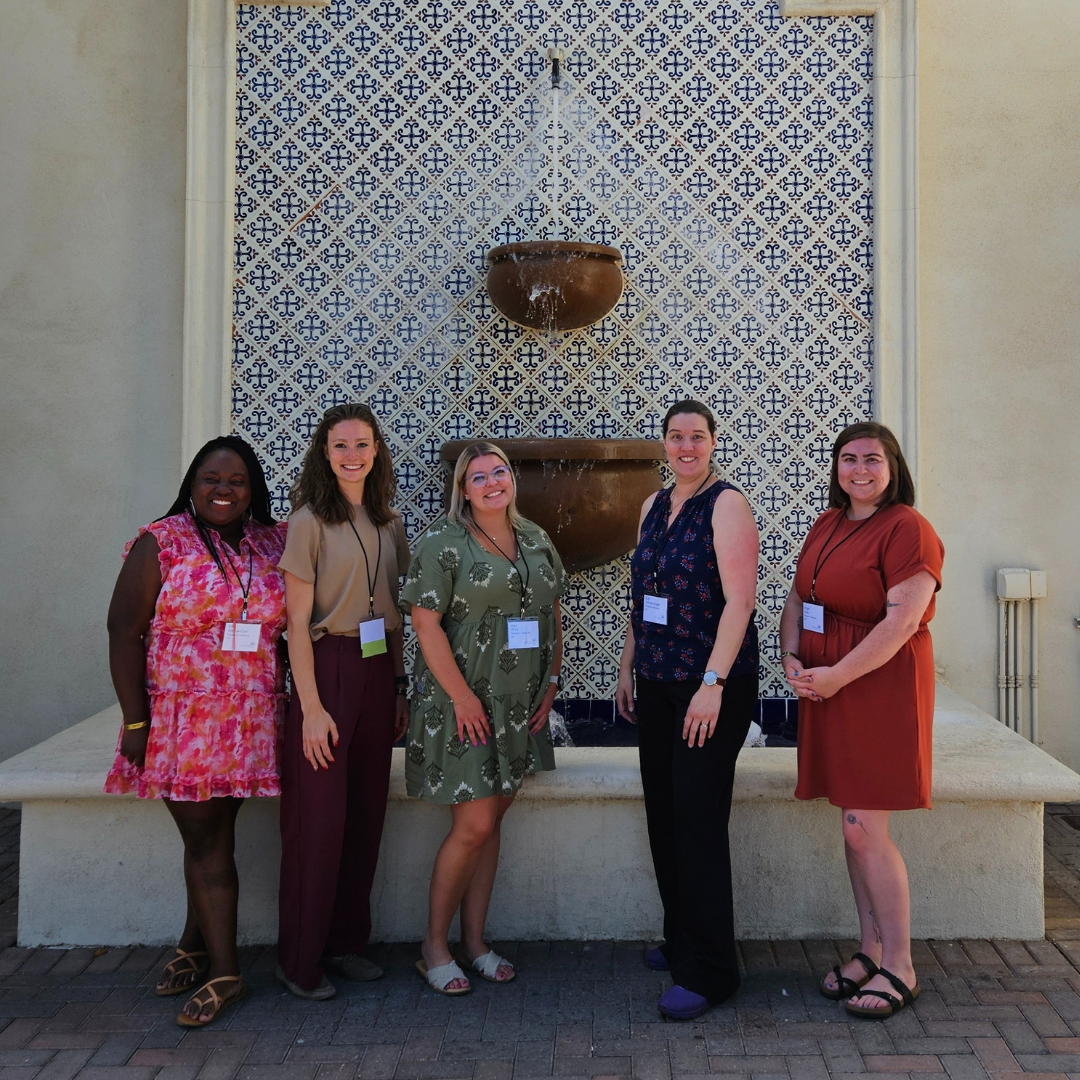
Prevention Network staff at the National Prevention Network Conference in Arizona.

Letter From the Director

Dear Prevention Professionals,

As we enter September, we celebrate National Recovery Month and National Youth Substance Use Prevention Month, recognizing the vital work you do in our communities. These observances remind us of the importance of our collective efforts in promoting health, wellness, and resilience across Michigan. We were thrilled to connect with a few of you at the NPN conference last month and look forward to further engagement at the upcoming SUD/CO Conference. Please join us at the Prevention Meet and Greet on Monday after sessions, or visit our booth in the exhibitor hall to share your insights and learn about our latest activities.

With the fiscal year drawing to a close, we’re busy wrapping up current projects and preparing for the exciting opportunities that lie ahead. We’re pleased to announce the addition of a technical assistance request form on our website, making it easier for you to access one-on-one support. Additionally, we have several training sessions on the horizon to further enhance your skills and knowledge in the prevention field. Your professional development remains a top priority for us as we strive to strengthen our prevention workforce.

As we look to the future, your feedback is invaluable in shaping our direction. We’re currently reviewing the insights you’ve shared, which will inform our planning for the coming years. Check out some of the notes we heard in our summary below. 

In lieu of our next newsletter, we’ll be sharing our annual report, highlighting our collective achievements and the impact of our work across Michigan. Thank you for your dedication to prevention and for partnering with us in this crucial mission. Together, we continue to make a difference in the lives of individuals and communities throughout our state.

With you in prevention,

Louise Montag, Executive Director

News from Parenting Awareness Michigan (PAM)


Exciting news—registration is now open for the 32nd Annual PAM Conference! This event brings together a diverse group of professionals, thought leaders, and innovators, all dedicated to advancing the field of parenting education and support.

We are confident that the engaging discussions, insightful presentations, and valuable networking opportunities will provide both inspiration and practical knowledge for all attendees.

Join us for a day of learning and collaboration at the Henry Center on MSU’s campus—featuring an incredible lineup of speakers!


For all conference-related details and information and to register, visit the PAM Conference webpage.

Thank You For Your Feedback!

Prevention Network recently conducted a feedback survey to assess how well we are meeting the needs of prevention professionals across Michigan. Overall, the feedback was very positive – 96% of respondents said Prevention Network had met their needs either “fairly well,” “very well,” or “extremely well.” When asked to rate the support received from staff, 88% said it was “very good” or “exceptional”. 


Respondents highlighted several areas where Prevention Network excels, including providing professional development opportunities, sharing resources and information, facilitating networking, and offering funding support to coalitions. The most requested additional activities were webinars, workshops, and funding opportunities. To improve our services, suggestions included offering more in-person events, increasing funding opportunities, expanding advocacy efforts, and providing more MCBAP-approved training. Many respondents also expressed interest in hearing more stories and best practices from other communities.


We greatly appreciate all the thoughtful feedback provided. This input will be invaluable as we further analyze your responses and plan for the future. We are committed to continuously improving our services to support the critical work of prevention professionals across the state. Thank you to everyone who took the time to share their perspectives with us.


 We look forward to implementing enhancements based on your suggestions in the coming months.

This section highlights upcoming events such as webinars, conferences, and workshops, providing you with valuable opportunities to engage with experts, learn new strategies, and network with peers, ultimately fostering collaboration and advancing knowledge in the prevention field. Check out events coming up in the next 3 months below:

See the full calendar of events here.

  • Addressing Challenges In Collection and Using Data – September 24th, 2024 – An intermediary-level course for SUD Prevention Professionals, this one-time webinar features Olivia Stuart, a research assistant with Carnevale Associates. Olivia serves as a subject matter expert with SAMHSA’s Central East Prevention Technology Transfer Center (PTTC) and Strategic Prevention Technical Assistance Center (SPTAC) and has presented at CADCA, NPN, and other national conferences. Click here to register for this event!
  • F.F.U.N. (Fourth Friday Unwind & Network) Coalition Support Group – September 27th, 2024 – Open to anyone who is part of or interested in becoming part of a community-based coalition addressing substance misuse prevention. Special invitation to current coalition coordinators. We will use this time to address common challenges and share tools both old and new. Feel free to enjoy your own lunch during this relaxed group. Join us here!
  • Michigan Youth Prevention Day – September 30th, 2024 – Join us for the first Michigan Youth Prevention Day at Michigan League, Ann Arbor, MI. Join us for a day full of youth speakers, team building activities, and a prevention career and coalition exploration fair! Register here and view the flyer for more information here!
  • Strengthening Youth Mental Health by Targeting Wellness in Parenting Programs and Training – October 10th, 2024 – This free webinar hosted by Parenting Awareness Michigan will provide information about the common models of wellness and how it relates to substance misuse, prevention, and mental health. Also, examine mental health effects of the Big 3 wellness, and learn about a 4-step evidence-based parenting model that enhances mental health of the youth. Click here to register now!
  • Alcohol Policy Issues Meeting – October 14th, 2024 – Every month on the Second Monday at 10 a.m. People across Michigan meet to discuss alcohol policy and local changes that impact the access and availability with the goal of preventing misuse and reducing the negative impacts on public health. Click here to join!
  • 32nd Annual Parenting Awareness Michigan Conference – November 8th, 2024 – This event is for individuals that work with parents and families, educators, service providers, school personnel, parent networks, coalition members, parent leaders, volunteers and anyone interested in parenting. Attendees can expect a learning opportunity about relevant issues, programs, and resources related to parents and families. Click here to register!
  • Alcohol Policy Issues Meeting – November 11th, 2024 – Every month on the Second Monday at 10 a.m. People across Michigan meet to discuss alcohol policy and local changes that impact the access and availability with the goal of preventing misuse and reducing the negative impacts on public health. Click here to join!
  • Coalition Support and Networking – November 26 & 27th, 2024 – Quarterly opportunity for anyone working with coalitions on substance misuse prevention in Michigan to gather and share. Click here to join!

If you haven’t already check out the following featured resources! To see a list of all new resources added to the resource library, see this link.

recovery month banner 2024

SAMHSA Releases  2024 National Recovery Toolkit


SAMHSA’s National Recovery Month Toolkit offers valuable resources to help celebrate and support individuals in recovery. This toolkit provides information on SAMHSA’s initiatives and highlights ways to spread awareness about recovery from mental and substance use disorders. By using these tools, we can collectively empower individuals in recovery and promote a healthier, more supportive community.


Click here to to access the toolkit.

The Center on Alcohol Marketing and Youth for National Youth Substance Use Prevention Month


The Center on Alcohol Marketing and Youth (CAMY) is a key resource for National Youth Substance Use Prevention Month. CAMY provides fact sheets, brochures, publications, reports, and a marketing gallery to help prevent and reduce alcohol-related problems among young people. Their public health approach examines how marketing factors—product, place, promotion, and price—impact youth drinking and related issues. CAMY’s resources are valuable tools for raising awareness and supporting prevention efforts in communities.


Click here to view this resource.


The Prevention Network newsletter delivers timely and comprehensive state and national updates, covering the latest news, research findings, and best practices in the prevention field, ensuring you stay well-informed and equipped to address emerging challenges and opportunities in your prevention efforts. Check out some national and state updates below:

Michigan Monthly Overdose Update July 2024


The Michigan Monthly Overdose Update, managed by the Michigan Overdose Data to Action (MODA) program, has been updated with the latest data for July. This update provides crucial insights into overdose trends and prevention efforts across the state. Stay informed on the current statistics and learn more about how Michigan is addressing the overdose crisis by reviewing the updated report.


Click here to review the report.

SAMHSA’s Language Access Plan (LAP)

SAMHSA has issued our updated Language Access Plan (LAP), a roadmap designed to provide meaningful access to our programs, services, and information to everyone, including individuals with non-English language preference (NELP) while promoting equity in behavioral health care for all.


Click here to review the plan.

We’ve received a brief legislative update compiled by Gabrielle Loew with the Barry County Substance Abuse Task Force. Please forward all questions to galoew@bccmha.org.


The update can be reviewed here.

Thank you for reviewing Prevention Network’s newsletter! If you have any feedback regarding this newsletter or ideas for our next newsletter, please email us at info@preventionnetwork.org. Lastly, a special thanks to Prevention Network’s Board of Trustees for supporting our mission, vision, and goals.

Prevention Network staff on a scavenger hunt in downtown Lansing, MI.

Letter From the Director

Dear Prevention Professionals,

I hope this newsletter finds you well. We have several exciting updates to share as we move into the height of summer. First, I’d like to draw your attention to the upcoming Michigan SUD Prevention Coalitions Conference on July 25. This event promises to be an excellent opportunity for learning and networking. Additionally, we encourage you to participate in the valuable webinars hosted by MYCN, MCRUD, PDO, and the MIHEN. These sessions offer a wealth of knowledge and resources to support your prevention efforts. We also offer MCBAP prevention CEUs for all of these events!! Check out our calendar for more. 

As we continue to shape our future initiatives, your input is crucial. Please take a moment to complete our feedback survey, which is open until August 2. Your responses will play a vital role in guiding our decisions moving forward.

Our staff have been diligently planning for the upcoming year, attending numerous meetings, conferences, and networking events to stay at the forefront of prevention strategies. We’re also working hard to update our website and share new resources to support your work. If you need any assistance or have questions, please don’t hesitate to reach out to us directly or submit a request through our TA request form. We’re here to help and are deeply grateful for the incredible work you’re doing in your communities. Your dedication to prevention makes a significant impact, and we’re honored to support your efforts.

With you in prevention,

Louise Montag, Executive Director

Message from Program Coordinator Mike Tobias:


Summer is in full swing and I hope you are enjoying it. Whether you like camping, biking, hiking, disc golfing, boating, etc…our great state offers something for everyone. Get out there today and enjoy Michigan and before you know it, fall will be here.

I hope you can join us for both of our remaining FY24 MCRUD general meetings, which are July 23 and August 27 from 9-10:30 a.m. During our July meeting, we are pleased to have Megan Crainer (Livingston County Community Alliance) present on Story Book Marketing. Our August 27 meeting will feature guest speaker Sarah Konefal (MPHI). 

MCRUD is also hosting a lunch and learn webinar on August 22 from 12-1pm. Jim Fell will be presenting the webinar, “Responsible Beverage Service Training and Enforcement: Does it work?” Click here for additional information and registration.


Lastly, please consider becoming a MCRUD member. Click here to see our membership packet, and I hope to see you at a MCRUD meeting or event soon!


We value your feedback and invite you to participate in the Prevention Network Feedback Survey if you haven’t already!


Click here to take the survey.


This is your chance to honestly tell us how we are doing as an organization and how we might improve. The survey is completely anonymous and takes about 5 minutes to complete. While we encourage you to answer as many questions as you feel comfortable, all questions are optional and can be skipped. If you have any questions, please contact us at info@preventionnetwork.org.


As a thank you for participating, you will be entered to win one of the following:

  • A complimentary registration to a Prevention Network hosted conference or training (such as Prevention Ethics, PAM Conference, SUD Prevention Coalitions Conference, MCRUD Shoalition, MIHEN conference, etc.)
  • A prevention gift basket from Prevention Network


After submitting the survey, you will see a link to share your contact information. This will only be used to select the winner and is not connected to the survey. The survey will close on August 2 at 5 pm, and winners will be announced by August 9. Thank you for helping us improve!

This section highlights upcoming events such as webinars, conferences, and workshops, providing you with valuable opportunities to engage with experts, learn new strategies, and network with peers, ultimately fostering collaboration and advancing knowledge in the prevention field. Check out events coming up in the next 3 months below:

See the full calendar of events here.

  • MCRUD General Meeting — July 23rd, 2024 — Join the Michigan Coalition to Reduce Underage Drinking general membership quarterly meeting to share updates from across the state about factors impacting our shared efforts to prevent underage alcohol use. Click here to join!
  • 2024 Michigan SUD Prevention Coalitions Conference — July 25th, 2024 — Get ready for dynamic speakers, interactive exhibitors, and the opportunity to connect with others across the state of Michigan and beyond. The theme for 2024 is R.I.C.H – Respect. Inform. Connect. Hope. We expect this conference to encourage and inspire professionals who are passionate about preventing substance misuse disorders in Michigan. Join us, we can’t wait to see you there! Click here for more info!
  • F.F.U.N. (Fourth Friday Unwind & Network) Coalition Support Group – July 26th, 2024 – Open to anyone who is part of or interested in becoming part of a community-based coalition addressing substance misuse prevention. Special invitation to current coalition coordinators. We will use this time to address common challenges and share tools both old and new. Feel free to enjoy your own lunch during this relaxed group. Join us here!
  • 2024 National Meeting (for those working in higher education) — July 30th, 2024 – August 1st, 2024— The conference experience offers a blend of educational opportunities, networking, and collaborative experiences for which the conference is known. It is an ideal conference for those working within the alcohol and drug continuum with college students, including both prevention and recovery. Visit the conference web page to learn more: https://hecaod.osu.edu/national-meeting/
  • PDO Webinar – August 7th, 2024—Empowering Prevention: Understanding Substance Use Disorders and Promoting Recovery Pathways. Join us to learn common SUD terminology, risk and protective factors, and recovery resources, including local resources provided by FAN ( Face Addiction Now, formerly known as Families Against Narcotics). Click here to register!
  • Alcohol Policy Issues Meeting – August 12th, 2024 – Every month on the second Monday at 10 AM, people across Michigan meet to discuss alcohol policy and local changes that impact access and availability with the goal of preventing substance misuse and reducing the negative impacts on public health. 
  • PAM Webinar – August 21st, 2024 – But Men Don’t Do Feelings! Using Mindful Techniques With Male Caregivers to Improve Their Relationships. Learn ways to help fathers and male caregivers pay attention to stress triggers during times of conflict, frustration and disagreement; especially in times of receiving overwhelming news. Click here to register!
  • F.F.U.N. (Fourth Friday Unwind & Network) Coalition Support Group – August 23rd, 2024 – Open to anyone who is part of or interested in becoming part of a community-based coalition addressing substance misuse prevention. Special invitation to current coalition coordinators. We will use this time to address common challenges and share tools both old and new. Feel free to enjoy your own lunch during this relaxed group. Join us here!
  • MCRUD General Meeting – August 27th, 2024 – Join Michigan Coalition to Reduce Underage Drinking general membership quarterly meeting to share updates from across the state about factors impacting our shared efforts to prevent underage alcohol use.
  • PFS Coalition Support & Networking – August 27th & 28th, 2024 – Quarterly opportunity for anyone working with coalitions on substance misuse prevention in Michigan to gather and share. Click here to join!
  • Prevention Ethics – August 29th, 2024 – Join us, Prevention Network, and Eaton RESA to learn about the ethics in prevention work. Gain insight on how to navigate through ethical dilemmas by utilizing a decision-making model! Click here to register!
  • Alcohol Policy Issues Meeting – September 9th, 2024 – Every month on the second Monday at 10 AM, people across Michigan meet to discuss alcohol policy and local changes that impact access and availability with the goal of preventing substance misuse and reducing the negative impacts on public health. 
  • MIHEN Meeting – September 12th, 2024 – These quarterly meetings allow for those of us working in prevention in higher education to come together and discuss how we can work as one to prevent substance misuse on our campuses. Click here to join!
  • F.F.U.N. (Fourth Friday Unwind & Network) Coalition Support Group – September 27th, 2024 – Open to anyone who is part of or interested in becoming part of a community-based coalition addressing substance misuse prevention. Special invitation to current coalition coordinators. We will use this time to address common challenges and share tools both old and new. Feel free to enjoy your own lunch during this relaxed group. Join us here!

If you haven’t already check out the following featured resources! To see a list of all new resources added to the resource library, see this link.

CADCA Releases Their CADCA Congressional Election Guide 2024


The CADCA Election Guide gives you the tools you need to raise and address prevention, treatment, harm reduction, and recovery issues at campaign events around the country.

The CADCA Guide includes the following information:

  • Candidates for the President of the United States and their Contact Information (page 3).
  • How to raise drug misuse and underage drinking issues with the candidates (page 4)
  • Sample questions to get the candidates on record (pages 5-7)
  • The Election Center (Appendix 1) (pages 7-11)
  • Points of Contact for State Boards of Elections (Appendix 2) (pages 12-16)
  • A follow-up survey to document the candidates’ positions (Appendix 3) (pages 17-18)
  • A summary of relevant federal tax and election laws for 501(c)(3) nonprofit organizations (Appendix 4) (page 19)

CADCA’s hope is that coalitions around the country will use this guide to let as many candidates as possible running for office in 2024 know that they must seriously address alcohol, nicotine and drug issues as part of their campaigns. In that way, the winners of these elections will know these issues are of great concern to their constituents when they take office.


Click here to download the guide.

The ARDI or Alcohol-Related Disease Impact application now includes data from 2020-2021!


ARDI or Alcohol-Related Disease Impact, is an online application that provides national and state estimates of alcohol-related health impacts, including deaths and years of potential life lost (YPLL). These estimates are calculated for 58 acute and chronic causes using alcohol-attributable fractions, and are reported by age and sex. By using ARDI, you can find your state’s fact sheet for addressing excessive alcohol use.


Click here to use the application.


The Prevention Network newsletter delivers timely and comprehensive state and national updates, covering the latest news, research findings, and best practices in the prevention field, ensuring you stay well-informed and equipped to address emerging challenges and opportunities in your prevention efforts. Check out some national and state updates below:

Michigan Suicide Prevention Plan: A Systems Level Approach to Preventing Suicide

“Suicide was the 10th leading cause of death overall in the nation and in Michigan for 2001–2020. In 2022, on average, one person died by suicide every six hours in our state. We must act now to reverse this trend. Suicide must be addressed in a comprehensive, collaborative, and coordinated way.

The Plan will be used to guide statewide, multisectoral efforts to decrease fatal and non-fatal suicidal behavior. The proposed strategies, based on the most current data and research available, will serve as a framework for coordinated and complimentary suicide prevention efforts across Michigan. ”


Click here to view the plan and read more from Sarah Lyon-Callo, Senior Deputy Director/State Epidemiologist

July is Minority Mental Health Awareness Month!

The Biden-Harris Administration, through the U.S. Department of Health and Human Services, has released the 2024 National Strategy for Suicide Prevention and its Federal Action Plan. Developed with input from over 20 federal agencies, the strategy offers a comprehensive, society-wide approach to address the urgent public health crisis of suicide, which claimed over 49,000 lives in the U.S. in 2022. It includes 200 specific actions aimed at improving prevention, intervention, and recovery services, with a focus on integrating suicide prevention into various community systems and prioritizing equity for disproportionately affected populations. This coordinated effort emphasizes the importance of partnerships and lived experience in creating effective, data-driven strategies to reduce suicide rates nationwide.


Click here to read the full article. 

The Michigan legislature isn’t back in session until the end of July. You can find the Senate session calendar here. Below are a few bills we are following.


  • US S 4226 A bill to decriminalize and deschedule cannabis, to provide for reinvestment in certain persons adversely impacted by the War on Drugs, to provide for expungement of certain cannabis offenses, and for other purposes. 
    • Last action: May 01, 2024, Senate: Read twice and referred to the Committee on Finance.
  • MI SB 807 Marihuana: other; individuals who are 19 years of age or older; allow to be employed by or volunteer for marihuana establishments. Amends title & secs. 4, 5, 10 & 11 of 2018 IL 1 (MCL 333.27954 et seq.). 
    •  Last action: Apr 09, 2024, Senate: REFERRED TO COMMITTEE ON REGULATORY AFFAIRS
  • MI SB 730 Liquor: retail sales; displaying co-branded alcoholic beverages adjacent to certain products; prohibit. Amends 1998 PA 58 (MCL 436.1101 – 436.2303) by adding sec. 609k. 


Last action: Jun 26, 2024: House referred to Committee on Regulatory Reform

Thank you for reviewing Prevention Network’s newsletter! If you have any feedback regarding this newsletter or ideas for our next newsletter, please email us at info@preventionnetwork.org. Lastly, a special thanks to Prevention Network’s Board of Trustees for supporting our mission, vision, and goals.

Mike Tobias, MCRUD Program Coordinator, receiving the Cynthia Abrams Award. 

Letter From the Director

Happy Spring! As the season of growth unfolds, it’s fitting that a recent icebreaker centered on words associated with Spring, with someone suggesting “growth” – these last few months have indeed been a period of profound growth and development.

I pen these words energized after an invigorating conference, eager to review the insights gained and reignite my passion for our crucial yet misunderstood work grounded in science for community well-being. Professional development replenishes our reserves in this demanding field, keeping skills current while facilitating invaluable connections to share experiences, learn from others, forge partnerships, and celebrate triumphs.

While virtual trainings provide constant education, I’ve missed the organic conversations between in-person breakouts. To sustain momentum beyond the flight home, we must digest information and determine next steps. Yet how often do we find the luxury to slow down post-conference?

My new(ish) approach to conferencing divides notes into takeaways/next steps, highlights for follow-up, and connections to contact. I set aside time the week following to review and select 1-2 actions for the next month, such as sharing with colleagues, following up with presenters, meeting new contacts, or utilizing new skills/resources. If colleagues also attended, I debrief with them. I challenge you to identify one takeaway and one action step after your conferencing to aid professional growth.

Meanwhile, Prevention Network continues full steam ahead. We just wrapped up National Prevention Week; look forward to hosting a bowling fundraiser (6/23); and are planning the MIHEN conference (6/13), Inaugural Prevention Coalitions Conference (7/25), and PAM conference (11/8); and cannot wait to unveil new resources in the coming months. We’re also so proud of Mike Tobias’s Cynthia Abrams Award from the US Alcohol Policy Alliance. See our full newsletter for more on what we are up to!

We’re excited to share the latest updates on the Michigan Project to Prevent Prescription Drug/Opioid Overdose-Related Deaths (MI-PDO) grant initiative, focusing on reducing opioid-related deaths and adverse events in Calhoun, Genesee, and Wayne counties.


We’ve been working closely with the Michigan Department of Health and Human Services (MDHHS) during Year 3 of the grant. With significant support from MDHHS and WSU, we’ve made remarkable progress. Recently, we completed in-person site visits for all eight subrecipients, showcasing the exceptional work being done in Wayne, Genesee, and Calhoun counties.


Our key goals include enhancing community capacity, implementing safe prescribing practices, and increasing naloxone education and distribution. Subrecipients are actively tracking naloxone distribution data and have set an annual goal of distributing 500 kits as part of the statewide plan.


Throughout the grant period, subrecipients have been developing implementation steps around ten project areas aligned with the SAMHSA Opioid Overdose Prevention Toolkit. We’re grateful for the advisory council’s guidance, which has been instrumental in shaping our efforts.

As a program coordinator, Ieshia provides technical assistance to ensure subrecipients meet grant requirements and stay on track. The PDO grant has been pivotal in benefiting our communities by supporting education, healthcare, and economic development. Thanks to the dedicated efforts of our partners and subrecipients, the PDO grant continues to make a positive impact.


For more updates, be sure to check out the PDO monthly newsletter!

This section highlights upcoming events such as webinars, conferences, and workshops, providing you with valuable opportunities to engage with experts, learn new strategies, and network with peers, ultimately fostering collaboration and advancing knowledge in the prevention field. Check out events coming up in the next 3 months below:

See the full calendar of events here.

  • MCRUD Alcohol Policy Issues Meeting — June 10th, 2024 — Every month on the second Monday at 10 AM, people across Michigan meet to discuss alcohol policy and local changes that impact the access and availability with the goal of preventing substance misuse and reducing the negative impacts on public health.
  • 2024 MIHEN Conference — June 13th, 2024 — This year’s MIHEN Conference is focused on internal and external partnerships within college campuses. Looking at recovery, prevention, and treatment in higher education through a partnership lens allows professionals to better support students and meet the needs of those who are underrepresented. Click here to register!
  • Pins for Prevention — June 23rd, 2024 — Join us for a fun-filled evening of bowling, pizza, and soft drinks for just a $25 entry fee! Enjoy great company and exciting activities, including a silent auction with fantastic items up for grabs. Click here to get your tickets!
  • F.F.U.N (Fourth Friday Unwind & Network) Coalition Support Group – June 28th, 2024 – Open to anyone who is part of or interested in becoming part of a community-based coalition addressing substance misuse prevention. Special invitation to current coalition coordinators. We will use this time to address common challenges and share tools both old and new. Feel free to enjoy your own lunch during this relaxed group. Join us here!
  • MCRUD General Meeting — July 23rd, 2024 — Join Michigan Coalition to Reduce Underage Drinking general membership quarterly meeting to share updates from across the state about factors impacting our shared efforts to prevent underage alcohol use.
  • 2024 Michigan SUD Prevention Coalitions Conference — July 25th, 2024 — Get ready for dynamic speakers, interactive exhibitors, and the opportunity to connect with others across the state of Michigan and beyond. The theme for 2024 is R.I.C.H – Respect. Inform. Connect. Hope. We expect this conference to encourage and inspire professionals who are passionate about preventing substance misuse disorders in Michigan. Join us, we can’t wait to see you there! Click here to register!
  • F.F.U.N (Fourth Friday Unwind & Network) Coalition Support Group – July 26th, 2024 – Open to anyone who is part of or interested in becoming part of a community-based coalition addressing substance misuse prevention. Special invitation to current coalition coordinators. We will use this time to address common challenges and share tools both old and new. Feel free to enjoy your own lunch during this relaxed group. Join us here!
  • 2024 National Meeting (for those working in higher education) — July 30th, 2024 – August 1st, 2024— The conference experience offers a blend of educational opportunities, networking, and collaborative experiences for which the conference is known. It is an ideal conference for those working within the alcohol and drug continuum with college students, including both prevention and recovery. Visit the conference web page to learn more: https://hecaod.osu.edu/national-meeting/

If you haven’t already check out the following featured resources! To see a list of all new resources added to the resource library, see this link.

SAMHSA Announces Art of Recovery Project


Submissions are open May 7 to June 28 for the Art of Recovery Project with categories for youth 13-17 and adults 18+. Artists may submit in two categories: painting, drawing, or mixed media, and photography. Selected entries will be posted on SAMHSA’s website as part of an online exhibit, Gallery of Hope: Artistic Expression of Recovery Across the Nation. The online gallery will launch in September and run throughout the month to celebrate National Recovery Month.


Click here for more information.

June is LGBTQIA+ Pride month! To celebrate and recognize those folks, the New England PTTC is hosting a virtual webinar titled “Health Disparities Encountered in LGBTQ+ Communities of Color: From Theory to Practice.”


This event will delve into the unique health challenges faced by individuals who belong to both sexual and gender minorities and racial and ethnic minorities—groups that the NIH has identified as experiencing significant health disparities. The presentation will explore how an intersectionality framework and minority stress theory can enhance our understanding of these complex dynamics. Attendees will gain practical insights into addressing these disparities in behavioral health care, fostering better health outcomes for these often-overlooked communities.


Click here for more information.

The Prevention Network newsletter delivers timely and comprehensive state and national updates, covering the latest news, research findings, and best practices in the prevention field, ensuring you stay well-informed and equipped to address emerging challenges and opportunities in your prevention efforts. Check out some national and state updates below:

Governor Signs Proclamation Declaring May as Asian American and Pacific Islander Heritage Month

Governor Gretchen Whitmer has proclaimed May as Asian American and Pacific Islander (AAPI) Heritage Month in Michigan, celebrating the diverse and vibrant AAPI communities across the state. Highlighting Michigan as a place of opportunity and inclusivity, Whitmer and state leaders, including Senators Sam Singh and Stephanie Chang, and Representatives Ranjeev Puri and Mai Xiong, emphasized the significant contributions of AAPI individuals to the state’s cultural, economic, and social fabric. AAPI Heritage Month honors the rich history and achievements of Asian Americans, Native Hawaiians, and Pacific Islanders, including milestones like the arrival of the first Japanese immigrants in 1843 and the completion of the transcontinental railroad in 1869. With approximately 377,181 Asian Americans making up 3.7% of Michigan’s population, this month serves as a vital recognition of their ongoing impact and legacy.

Click here to read the full article. 

Updates with 2022 Data Have Been Made to the MI-SUVI

(MDHHS) has introduced the Michigan Substance Use Vulnerability Index (MI-SUVI), a new tool designed to help communities address substance use issues more effectively. Unlike traditional methods that relied solely on overdose mortality data, MI-SUVI incorporates a broader range of factors, including access to services, social vulnerability, and substance use burden, to generate a comprehensive county-level vulnerability score. This innovative index aims to facilitate data-driven, community-focused substance use disorder programming, particularly as Michigan distributes $800 million from a national opioid settlement over 18 years. The tool provides detailed county scorecards and will soon include sub-county data to further refine resource allocation. Highlighted by Dr. Natasha Bagdasarian and supported by local health leaders, MI-SUVI identifies Michigan’s most vulnerable counties, such as Oscoda, Wayne, Clare, Schoolcraft, and Oceana, enabling targeted interventions and enhanced support for those at greater risk of adverse substance use outcomes.

Click here to access this resource. 

Biden-Harris Administration Releases National Strategy for Suicide Prevention and First-Ever Federal Action Plan

The Biden-Harris Administration, through the U.S. Department of Health and Human Services, has released the 2024 National Strategy for Suicide Prevention and its Federal Action Plan. Developed with input from over 20 federal agencies, the strategy offers a comprehensive, society-wide approach to address the urgent public health crisis of suicide, which claimed over 49,000 lives in the U.S. in 2022. It includes 200 specific actions aimed at improving prevention, intervention, and recovery services, with a focus on integrating suicide prevention into various community systems and prioritizing equity for disproportionately affected populations. This coordinated effort emphasizes the importance of partnerships and lived experience in creating effective, data-driven strategies to reduce suicide rates nationwide.

Click here to read the full article. 

Understanding the Relationship Between Social Determinants of Health and Health Disparities 

Understanding the relationship between social determinants of health and health disparities is crucial for prevention professionals tackling substance misuse. Social determinants significantly impact individuals’ vulnerability to substance use disorders and their access to effective treatment and prevention services. To equip prevention professionals with the knowledge and tools to address these complex factors, SAMHSA offers two self-guided courses: “What are Behavioral Health Disparities?” and “Incorporating the Social Determinants of Health into Substance Use Prevention.” These courses provide comprehensive insights into how systemic inequities contribute to behavioral health disparities and offer practical strategies for integrating social determinants into prevention efforts. By understanding and addressing these foundational elements, professionals can create more effective, equitable prevention programs that better serve all communities.

What Are Behavioral Health Disparities? 

Incorporating the Social Determinants of Health into Substance Use Prevention

The following are legislative updates that have occurred at the federal and state level related to substance use:

  • MI SB 730 Liquor: retail sales; displaying co-branded alcoholic beverages adjacent to certain products; prohibit. Amends 1998 PA 58 (MCL 436.1101 – 436.2303) by adding sec. 609k. 
    • Last action: Feb 28, 2024, Senate: REFERRED TO COMMITTEE ON REGULATORY AFFAIRS
  • US S 4226 A bill to decriminalize and deschedule cannabis, to provide for reinvestment in certain persons adversely impacted by the War on Drugs, to provide for expungement of certain cannabis offenses, and for other purposes. 
    • Last action: May 01, 2024, Senate: Read twice and referred to the Committee on Finance.
  • MI SB 807 Marihuana: other; individuals who are 19 years of age or older; allow to be employed by or volunteer for marihuana establishments. Amends title & secs. 4, 5, 10 & 11 of 2018 IL 1 (MCL 333.27954 et seq.). 
    •  Last action: Apr 09, 2024, Senate: REFERRED TO COMMITTEE ON REGULATORY AFFAIRS
  • MI SB 57 and MI SB 58 Controlled substances: drug paraphernalia; sale of nitrous oxide devices; prohibit. Amends sec. 7453 of 1978 PA 368 (MCL 333.7453). TIE BAR WITH: SB 0058’23 
    • Last action: Mar 12, 2024, Senate: ASSIGNED PA 0019’24 WITH IMMEDIATE EFFECT

Thank you for reviewing Prevention Network’s newsletter! If you have any feedback regarding this newsletter or ideas for our next newsletter, please email us at info@preventionnetwork.org. Lastly, a special thanks to Prevention Network’s Board of Trustees for supporting our mission, vision, and goals.